Increasing heat poses risks to human health and labor productivity. We examine the problem and consider solutions.
The Problem of Heat
People are ill-equipped to thrive or survive in intense heat. The effect of heat on the human body can be measured by a variety of metrics, most commonly wet bulb globe temperature (WBGT), which considers the effects of air temperature, humidity, radiation, and ventilation. Animals have no natural refrigeration cycle and rely on evaporation (the latent heat of vaporization) for cooling. WBGT thus includes the environmental variables driving heat transfer into the body (temperature, radiation) and those modulating heat transfer out of the body via evaporation (temperature, humidity, ventilation). At WBGTs \(\geq\) 25 \(^{\circ}\)C, strenuous work risks heat-related illness; at WBGTs \(\geq\) 30.5 \(^{\circ}\)C, young, healthy subjects could not carry out simple tasks mimicking daily activities; at WBGTs \(\geq\) 32 \(^{\circ}\)C, short periods of work, even by a healthy individual, risks death; and at WBGTs \(\geq\) 35 \(^{\circ}\)C, even for stationary individuals, are deadly after a few hours.
WBGTs, already high in many parts of the world, are increasing, decreasing labor productivity, increasing mortality, and reducing quality of life. Figure 1 shows, for every country and down to its provinces and districts, how many people face a given number of days a year at or above a heat threshold, from the recent climate to 2090 under two emissions pathways. By FEWS NET's count, India will experience over 100 billion person-days in excess of the 30 \(^{\circ}\)C WBGT threshold in 2030, and Indonesia, Bangladesh, and Pakistan more than 20 billion person-days each in 2030. Even in the USA, the number of person-days in excess of the 30 \(^{\circ}\)C threshold exceeds 1 billion person-days.
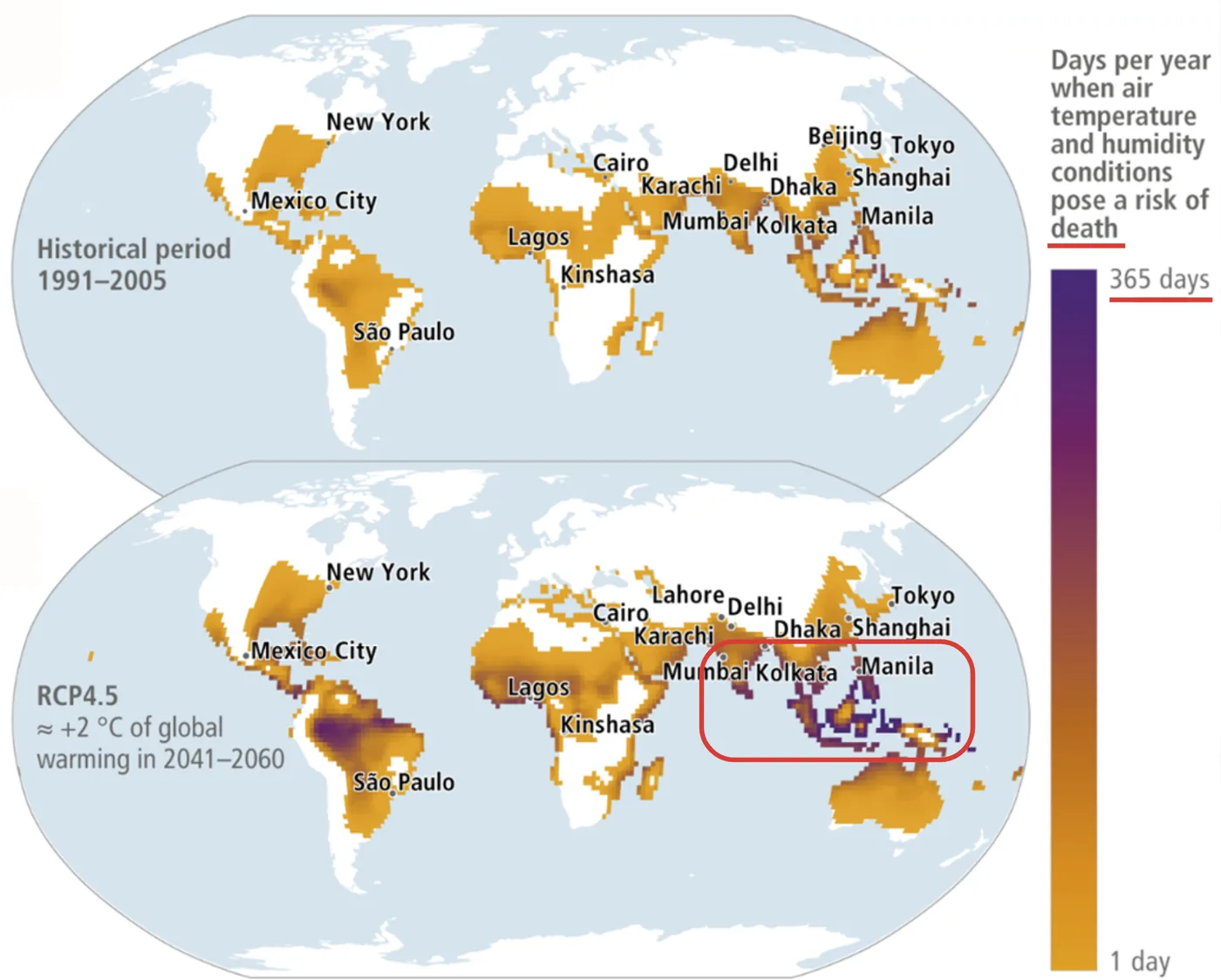
Sadly, I did not scrape the website in full before the regime change, but, in short, things get considerably worse as the century progresses. By 2050, per the latest IPCC report, Figure 2, substantial regions of the world will be subject to conditions risking death. Concernedly, too, as the People layer of Figure 1 shows for 2050, the regions with the most extreme conditions are substantially populated. Moreover, their populations are (increasingly) urban, where the effects of environmental heat are made more severe.
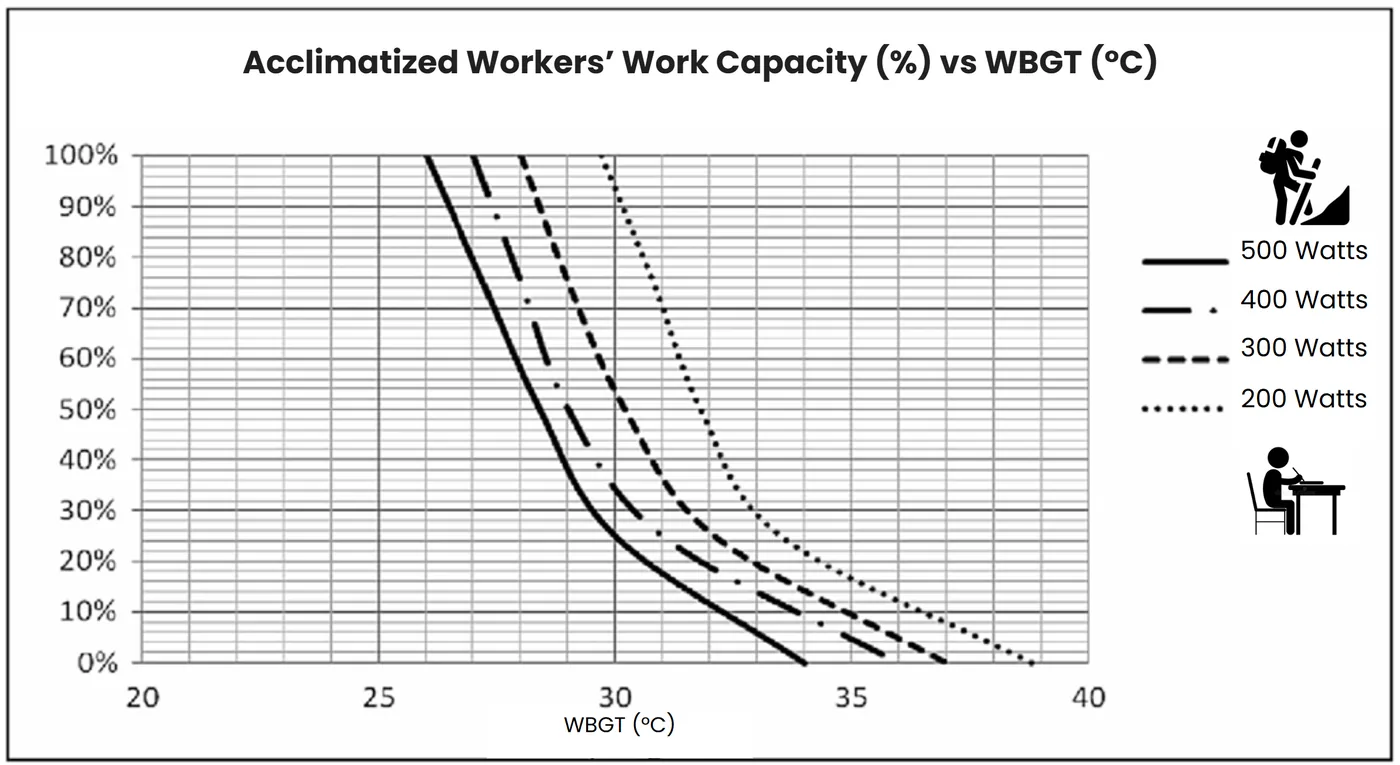
Aside from humanitarian and health arguments, which might induce a government or NGO to buy cooling products, provided a sufficiently low cost of cooling and sufficiently high wages, a rational private actor might buy cooling for their labor. Labor productivity, both intellectual and physical, decreases drastically with increasing WBGTs–see Figure 3. Accordingly, there is great economic value in investing in cooling even in regions or during periods where WBGTs do not risk injury or death.
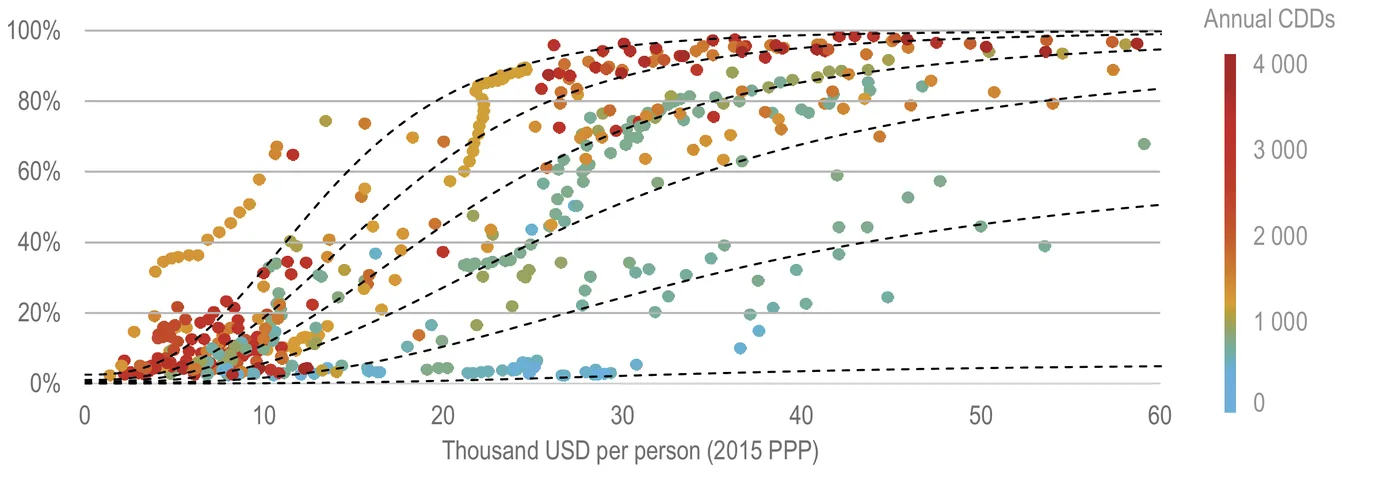
Finally, aside from economic inducements, people, predictably, buy air conditioning for comfort as their income rises. Figure 4.
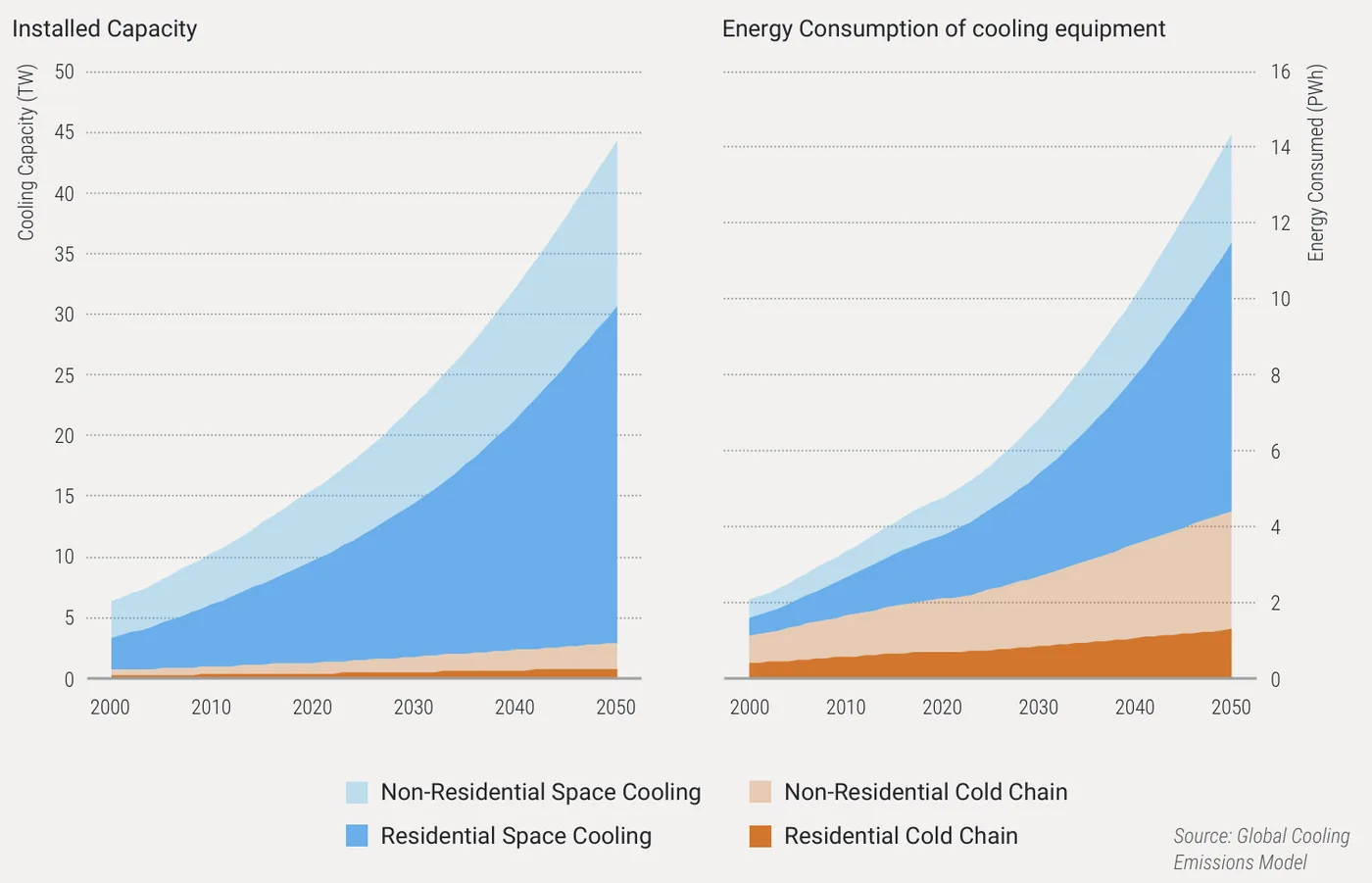
Because of all of the aforementioned drivers, the total market for cooling equipment, but particularly AC, is expected to increase dramatically in the coming decades, as well as its electricity consumption. Figure 5 shows UN estimates of AC consumption. Note that global electricity generation is only on the order of tens of PWhs; cooling represented 19% of total electricity consumption in 2022, a portion expected to increase. Installed capacity is relatively easy to convert into market size; air conditioning is typically sold at approximately $1000 per ton cooling. There are 3517 W cooling per ton cooling, so 1 TW cooling costs approximately $ 280 B. AC manufacturers have a net profit margin of approximately 10%, yielding a $ 28 B profit per TW cooling sold.
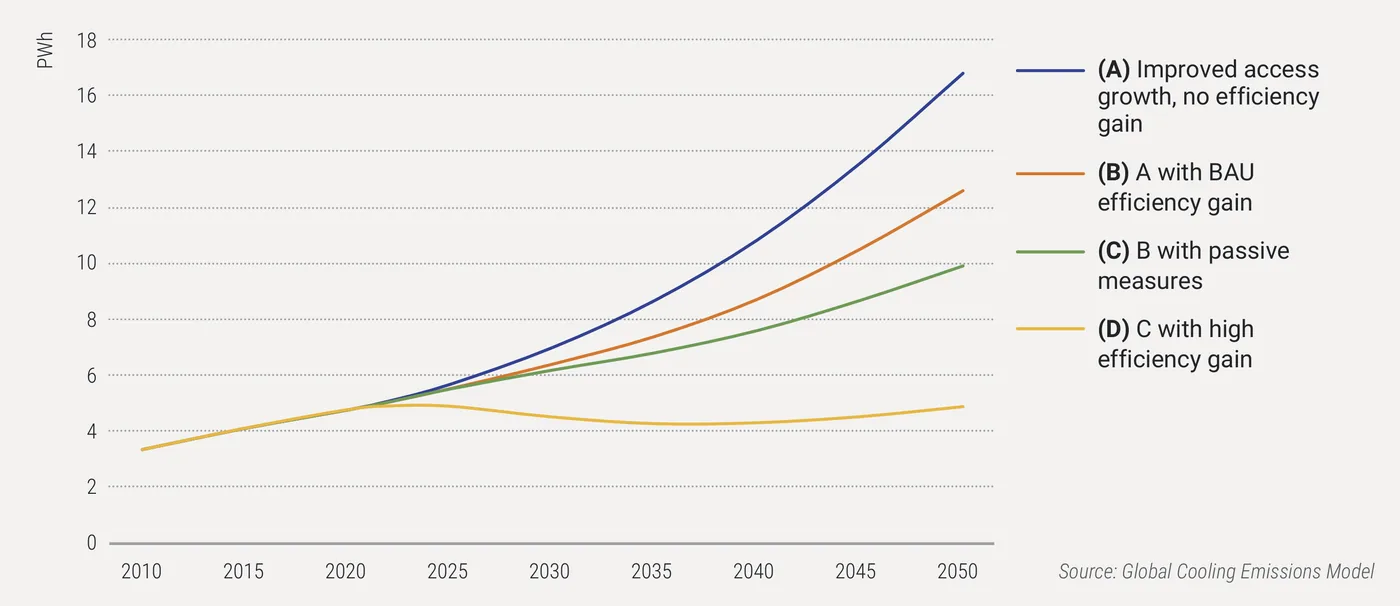
Advances in efficiency yield enormous savings in electricity consumption and carbon. Figure 6 demonstrates the gains the UN Environment Program expects are possible given different assumptions of innovation and adoption. Furthermore, operational expenditures on electricity correspond directly to energy consumption; manufacturers of more efficient units would save opex and could extract a greater margin or outcompete traditional players.
Advances in Cooling
First, I constrain the domain of cooling to vapor-compression refrigeration, bound its performance, explain the potential benefits of separate dehumidification, and consider a number of relevant innovations and related startups.
Mechanisms of Cooling
Almost all global cooling capacity used in air conditioning operates using a vapor compression cycle, wherein evaporation of the coolant is used to provide cooling power and a compressor is used to increase pressure to allow condensation and heat ejection from the loop.
There are several alternatives. Evaporative cooling, provided a source of water, is exceptionally cheap, and is growing in adoption in markets like India. Evaporative cooling can, in a perfect system, only cool air from its dry bulb temperature to its wet bulb temperature (often a difference of only a few degrees). Moreover, because the cooling power achievable with evaporative cooling decreases as a function of local humidity (which is often correlated to local water availability/cost), it is often most effective in markets with the least available liquid water.
Cooling can also be achieved by absorption and adsorption. In absorption, two coolants are used. One coolant provides cooling power via evaporation at low pressure before absorption into the second, which is then heated to re-separate the two. This video explains. Fewer moving parts are required than a vapor compression cycle, but the resulting coefficient of performance (COP) is lower. \(COP = \frac{Q_{cooling}}{W_{input}}\) where \(Q_{cooling}\) is the cooling power and \(W_{input}\) is the input power. Adsorption is similar but the refrigerant is adsorbed into a second material that is a solid, which can be heated to separate them. Adsorption is even simpler, but is an intermittent process and has an even lower coefficient of performance.
Cooling can be achieved radiatively by producing a selective blackbody, with high emissivity in the 8 \(\mu\)m - 13 \(\mu\)m infrared range, where the atmosphere is transparent, and high reflectivity elsewhere, particularly in the peak of the solar spectrum (0.3 \(\mu\)m - 2.5 \(\mu\)m), as to maximize power radiated to space and minimize power absorbed. Skycool Systems, with which you are likely familiar, has been trying to commercialize radiative cooling for more than a decade (a source of much excitement to me in high school). Radiative cooling systems, though theoretically capable of cooling to the temperature of space (3 \(^{\circ}\)K), competing heat transfer mechanisms–absorption (of radiation) as well as surface conduction and convection–limit cooling to 5 \(^{\circ}\)C to 10 \(^{\circ}\)C during the day, and a majority of the performance can be achieved by much cheaper systems that only reflect light. Recently, SRI developed a paint that radiatively cools.
Cooling can also be achieved thermoelectrically, magnetically, or thermoacoustically, but these methods are not practical for air conditioning and are left to the reader for exploration.
Accordingly, air conditioners operate via a classic vapor-compression cycle. The COP of the system in removing heat from air is limited by the Carnot COP,
Real systems are irreversible (generate entropy) and are subject to a variety of losses (compressor efficiency, expansion valve loss, flow losses, etc.) that lower COP and are largely unrecoverable (or are uneconomic to recover). Typical air conditioners rarely realize a COP greater than 3-5 in normal operational conditions.
However, the actual energy required to cool a unit volume of air depends on its composition. Water has high thermal mass (4.18 kJ/(kg \(\cdot\) K)) and particularly high heat of fusion (334 kJ/kg), so the concentration of water in a volume of air substantially affects the energy required to cool it, particularly if the evaporator is substantially cooler than the air's dew point. Similarly, a cooling unit of a probe operating on Venus would have to pay the penalty of the heat of fusion of sulfuric acid (71 kJ/kg), which would condense on its surface.
Accordingly, if the water content of the air to be cooled can be reduced via some lower-energy mechanism than direct cooling, efficiency of the combined cooling system can be substantially increased; separating the latent and sensible loads is worthwhile.
Moreover, reducing the water content of air (the humidity) reduces WBGT even at constant temperature; in some applications, the refrigeration loop may be possible to eliminate entirely.
Dehumidification
A number of mechanisms exist to reduce the water content of air. Vapor must either be cooled below its dew point, brought in contact with a substance having a strong affinity for water, or have its partial pressure made to exceed that on the other side of a membrane or within a chemical bed.
Performance Bounds
We can establish lower bounds on the energy required for dehumidification. The ideal energy of separation is the Gibbs free energy of mixing
For ideal gasses, \(\Delta H_{mix} = 0\), and the specific Gibbs free energy of mixing (energy required for unmixing), derived here, for mixture with molar fractions \(X_1\) and \((1-X_1)\) is given by
You may recognize this equation from DAC (to compute the minimum energy cost of CO\(_2\) separation as a function of concentration). For water vapor at 50% relative humidity at 25 \(^{\circ}\)C, Equation 3 yields approximately 0.003 kWh/kg (water removed). This, of course, assumes an ideal process; any real process would be subject to a host of additional losses.
If water is condensed to liquid, the full heat of vaporization of water must be paid, approximately 0.68 kWh/kg (water removed), though the heat of vaporization is a function of temperature and mildly of pressure. The total work required as input is then the heat of vaporization divided by the COP.
where \(T_{hot}\) is the ambient temperature and \(T_{cold}\) is the dew point. For a typical system with \(COP = 5\), this yields \(w \approx 0.14\) kWh/kg.
In summary, processes allowing dehumidification without condensation might achieve considerably lower energy intensities for dehumidification, though any realized process will differ substantially from the physical ideal.
Mechanisms of Dehumidification
Cooling from any source, compression/expansion cycles, refrigeration cycle, endothermic reaction, thermoelectric cooling, etc. can condense water. Mechanisms of cooling are considered in Section 2. At minimum, the heat of vaporization must be produced in cooling power to condense the water, but, in addition to the usual sources of loss in the cooling system, the air must often be reheated to the desired output temperature. The overcooling of air for the purpose of dehumidification is inefficient. Specifically, if one intends to dehumidify air, one must cool the air to approximately 10 \(^{\circ}\)C to 15 \(^{\circ}\)C, whereas if one needs only to cool the air to approximately 20 \(^{\circ}\)C to 25 \(^{\circ}\)C, where far more favorable COPs are possible. Nonetheless, dehumidifying and cooling using the same system is simpler than other methods and widely employed.
Affinity-based dehumidification is possible using adsorption or absorption. Desiccants (hygroscopic materials), such as silica, zeolites, or calcium chloride, adsorb water, but, requiring some cycling to regenerate, suffer many of the same challenges associated with adsorbents of CO\(_{2}\). Energy is bounded by the heat required for regeneration, the heat of absorption. Similarly, absorption systems are possible using lithium bromide, lithium chloride, strong salt solutions, or glycols, enabling continuous flow processes, but similarly require some payment of heat, the heat of absorption, to release water and regenerate. Moreover, many of the aforementioned absorbents are highly corrosive. Heats of adsorption and absorption for common desiccants and absorbents of water are listed in Table 1.
| Material | Heat of Sorption (kWh/kg H\(_2\)O) | Source |
|---|---|---|
| Silica Gel | 0.67–0.78 | Springer Study on SAPO-34 and Silica Gel |
| Zeolites / Molecular Sieves | 0.83–1.17 | Springer Study on Zeolites |
| Lithium Chloride (LiCl) | 0.78–0.86 | IIF Duhring Charts |
| Calcium Chloride (CaCl\(_2\)) | 0.67–0.81 | Oxford Review on Desiccant Cooling |
| Lithium Bromide (LiBr) | 0.78–0.97 | IIF Thermal Properties of LiBr Solutions |
Table 1. Heats of Adsorption and Absorption for Various Desiccants and Absorbents
In addition to the heat of sorption, one must provide the sensible heat required to raise the temperature of the mass of the water and adsorbent or absorbent to that required for regeneration. In practice, the sensible heat is usually less than an order of magnitude smaller than the heat of sorption. Nonetheless, as the air being dehumidified is rarely at temperatures close to the heat of regeneration (where the adsorbent or absorbent would not be particularly effective anyway), some substantial temperature swing is necessary. The sensible heat for the materials in Table 1 can be calculated using the data in Table 2.
| Material | \( c_p \) (kJ/kg·K) | \(T_{regneration}\) (\(^{\circ}\)C) | Source |
|---|---|---|---|
| Silica Gel | 0.84 | 100–150 | Engineering ToolBox |
| Zeolites | 0.92 | 150–300 | Engineering ToolBox |
| Lithium Chloride (LiCl) Solution | 3.0–3.6 | 60–90 | F-Chart Software |
| Calcium Chloride (CaCl\(_2\)) Solution | 2.5–3.2 | 60–90 | F-Chart Software |
| Lithium Bromide (LiBr) Solution | 3.3–3.8 | 60–90 | F-Chart Software |
Table 2. Specific heat capacities and typical regeneration temperatures of various desiccants and absorbents
Even simply considering the heats of adsorption or absorption, however, affinity-based processes seem considerably more energy intensive than vapor-compression-based dehumidification. However, the heat necessary for regeneration is, in many applications, available as waste heat (even from a separate cooling process) or readily producible using cheap thermal solar, reducing the penalty of the energy cost. Moreover, allowing the primary vapor compression loop to operate at higher temperatures (approximately 20 \(^{\circ}\)C to 25 \(^{\circ}\)C rather than 10 \(^{\circ}\)C to 15 \(^{\circ}\)C) can save as much as 20% to 40% in energy in that process, depending on the configuration.
Membrane-based dehumidification uses a selective membrane, across which a driving gradient of some form exists, to separate water vapor from air without requiring a phase transition. In addition to the energy required for separation, some energy is required to maintain the driving gradient. For a system using a vacuum gradient, the energy required for mass transport is
where \(A\) is the surface area of the membrane, \(\Delta P\) is the pressure difference over the membrane, \(\eta_{membrane}\) is the membrane efficiency, and \(J\), the water vapor flux is given by Fick's law
where \(D_{H_2O}\) is the diffusivity of water vapor in the membrane, \(\delta\) is the membrane thickness, and \(C_{H_2O, i}\) are the water vapor concentrations on each side. The work required to draw vacuum is
Here \(\gamma\) is the specific heat ratio. The actual outputs of these equations depend on the system specifications, but provide a useful overview of the physical dimensions necessary to collect to gain a basic understanding of a proposed system's competitiveness.
Aside from the energy intensity of dehumidification by selective membranes, their use has, historically, been hampered by their frailty. Membranes must have large areas to operate efficiently, and producing membranes selective of water vapor of large areas that are durable for practical use is challenging.
One can imagine other methods of dehumidification–gas centrifuging, etc.–but any methods not discussed above are generally impractical for economically competitive dehumidification.
Wearable Cooling
In many situations, it is not practical to cool the environment wherein labor is performed (as when labor is outdoors). Some mechanism of cooling laborers in such circumstances exposed to high WBGTs is thereby useful to recovering labor productivity, protecting worker health, and ensuring conformance to any relevant heat-related regulation (as soon might be produced by OSHA).
For such applications, paramount performance metrics include the specific realizable cooling energy, specific cost, and any health or safety considerations associated with our cooling power source. We begin by determination of the heat actually necessary to extract and a description of the human physiology relevant to heat and its perception.
Energy Accounting
The cooling power necessary can be calculated from human heat balance, described by the net storage equation \[ S = (M - W) - (R + C) - E - Q_{\mathrm{vest}}, \] where \(S\) is the rate of heat storage in the body, \(M\) the metabolic heat production, \(W\) the external mechanical work \((\approx 0\) for most manual labor), \(R\) radiative loss, \(C\) convective loss, \(E\) evaporative loss, and \(Q_{\mathrm{vest}}\) the cooling power supplied by the vest. In steady state \((S=0)\), the vest must remove exactly the residual heat \((M - W) - (R + C) - E\), which is the key sizing criterion beyond simpler WBGT screening.
Metabolic rate \(M\) is estimated from MET tables standardized in ISO 8996, with values drawn from engineering sources. For a nominal 1.8 m\(^2\) body surface, \(M\) ranges from 105 W (1 MET, very light) to 790 W (7.5 MET, very heavy); see Table 3.
| Intensity | Example Task | M for 1.8 m\(^2\) Body (W) |
|---|---|---|
| Very light | Sitting | 105 |
| Light | Driving, assembly | 210 |
| Moderate | Brick-laying | 370 |
| Heavy | Shoveling, mining | 630 |
| Very heavy | Pick-and-shovel work | 790 |
Table 3. Representative metabolic heat production (M) by task intensity for a 1.8 m\(^2\) body, based on ISO 8996 MET values.
For individual sizing, one computes the Du Bois surface area \[ A_D = 0.202 \, m^{0.425} \, h^{0.725} \] and sets \[ M = \mathrm{MET} \times 58\,\mathrm{W\,m^{-2}} \times A_D. \]
Unassisted passive heat losses are often combined to a dry-exchange term \[ R + C = h_{r+c}(T_{\mathrm{sk}} - T_{\mathrm{op}}) \] with \(h_{r+c} \approx 6\text{--}8\,\mathrm{W\,m^{-2}\,K^{-1}}\) for light clothing \((\approx 0.6 \, \text{clo})\) and low airspeed. For example, with \(T_{\mathrm{sk}} = 35\,{}^\circ\mathrm{C}\) and \(T_{\mathrm{op}} = 34\,{}^\circ\mathrm{C}\), the loss is \(R + C \approx 6\,\mathrm{W\,m^{-2}}\).
Unassisted evaporative capacity is given by \[ E_{\max} = f_{\mathrm{pcl}}\,h_e\,(P_{\mathrm{sk}} - P_a), \] with \(h_e \approx 16\,\mathrm{W\,m^{-2}\,kPa^{-1}}\) and \(f_{\mathrm{pcl}} \approx 0.4\) for light clothing. Using saturation vapor pressure at the skin \((\approx 4.9\,\mathrm{kPa})\) and ambient vapor pressure \((3.5\,\mathrm{kPa})\) (e.g., WBGT 32 °C, RH \(\approx 70\%\)), we find \(E_{\max} \approx 9\,\mathrm{W\,m^{-2}}\), or a total passive cooling capacity of 15 W/m\(^2\).
Nonetheless, the situation is not as dire as it seems; unassisted humans dissipate far more in practice. Naked skin, with good ventilation and low humidity, can sustain sweat rates up to \(2.5\,\mathrm{L\,h^{-1}}\), removing over \(1{,}000\,\mathrm{W}\) of heat. Similarly, modest air speeds (\(\ge 1\,\mathrm{m/s}\)) boost combined radiative and convective heat loss into the \(50\text{–}100\,\mathrm{W\,m^{-2}}\) range. Workers also self-pace, take shade or fan breaks, ingest cold fluids, and wear “microclimate” garments. Heat-acclimated individuals sweat earlier, more profusely, and sustain these high rates for extended periods, whereas older or obese workers may need proportionally more assistive cooling. Transient heat storage during bursts of effort, followed by recovery periods, also enables sustainable operation even when instantaneous thermal balance is not achieved.
The vest cooling load is therefore \[ Q_{\mathrm{vest}} = (M - W) - (R + C) - E_{\max}. \] For example, an 80 kg, 1.80 m worker \((A_D \approx 2.0\,\mathrm{m}^2)\) doing 6 MET shoveling \((M \approx 696\,\mathrm{W})\) subtracts \(R + C \approx 12\,\mathrm{W}\) and \(E_{\max} \approx 18\,\mathrm{W}\) to yield \(Q_{\mathrm{vest}} \approx 666\,\mathrm{W}\). Over a 2 h shift, this is 4.8 MJ \((\approx 3.2\,\mathrm{kg}\) of ice) or an active 700 W chiller.
Physiology of Cooling
Comfort cooling relies on local thermoreceptors: cooling approximately 10% of the skin can shift whole-body thermal sensation by 1–2 PMV units with only 20–30 W of cooling. Devices such as the Embr Wave claim a perceptual drop of \(\sim 3\,{}^\circ\mathrm{C}\) with less than 5 W input. However, at WBGT \(\geq 29\,{}^\circ\mathrm{C}\) during heavy labor, perceptual relief alone does not halt core-temperature rise—lab tests show increases \(> 0.4\,{}^\circ\mathrm{C}/\mathrm{h}\) under such conditions—so full \(Q_{\mathrm{vest}}\) or enforced recovery breaks are advised.
More than \(75\%\) of the chemical energy liberated by contracting skeletal muscle is released as heat, while visceral organs account for a smaller but steady basal contribution. During heavy labor, the working limb muscles therefore dominate whole‑body heat production. Metabolic heat is convected by the blood to the skin, where it must be dissipated to the environment.
Skin regions that (i) receive a large, pressure-insensitive blood flow and (ii) place that blood in close proximity to the surface are the most effective physiological heat sinks. Glabrous skin of the palms, soles, ears, and upper face is richly supplied with arteriovenous anastomoses (AVAs) that can carry up to \(8\,\%\) of cardiac output at high core temperatures. Immersing only the hands and forearms in \(10\text{–}20^{\circ}\mathrm{C}\) water can extract \(\approx 120\text{–}200\,\mathrm{W}\) of heat—about one‑third of the metabolic heat of very heavy work—without the logistical burden of whole-body immersion.
At the cervical region, the carotid and jugular vessels present an attractive, high-flow target. However, practical neck-collar devices remove only \(\approx 15\text{–}40\,\mathrm{W}\) in the field; laboratory tests show negligible changes in core temperature, though perceptual strain and heart rate are reduced. Underarm (axillary) packs interact with similar blood vessels but the small surface area again limits heat flux to \(\lesssim 50\,\mathrm{W}\).
Psychophysical mapping reveals that cold-receptor density peaks on the face (forehead, cheeks, perioral zone), ears, and distal extremities; trunk sensitivity is an order of magnitude lower. Cooling a mere \(\sim 10\,\%\) of the skin over these nerve-dense areas can shift whole-body thermal sensation by 1–2 PMV units while removing only \(20\text{–}30\,\mathrm{W}\) of heat. Accordingly, pairing a small, perceptual cooler (face/neck) with a higher-capacity physiological cooler (palms or forearms or a chilled-water vest) provides the most effective combinational strategy.
Thermal regulation also varies across the population. Older adults exhibit up to \(50\,\%\) lower cutaneous vasodilatory capacity and sweat rates, reducing achievable dry and evaporative heat loss. Higher body-fat percentage and a lower surface-area-to-mass ratio similarly impair passive heat loss, increasing the need for active cooling. Conversely, women generally produce less absolute metabolic heat at a given external workload but may reach critical core temperatures sooner due to smaller blood volume. These differences suggest that cooling strategies should be scaled by individual traits such as age, sex, and body composition.
Our wearable solution, then, should likely remove \(\ge 50\%\) of the metabolic surplus through high-capacity sites (palms, forearms, full-torso vest) while allocating \(\approx 10\text{–}15\,\%\) of total cooling power to face/neck for perceptual relief. Local interface temperature should be kept close to \(15\text{–}20^{\circ}\mathrm{C}\); colder surfaces provoke vasoconstriction and reduce heat flux at AVA sites. And total cooled areas should be increased by \(+25\%\) for older workers or those with BMI \(\ge 30\).
We now consider the plausible mechanisms of cooling, which are described in abstract in Section 2. Materials proximate to the skin can either be used to enhance or augment passive cooling mechanisms (radiation and evaporation). Alternatively, active cooling can be provided by a heat sink (like ice or a phase change material) or by a heat engine (like a vapor compression loop or Peltier element).