Things in space are far away
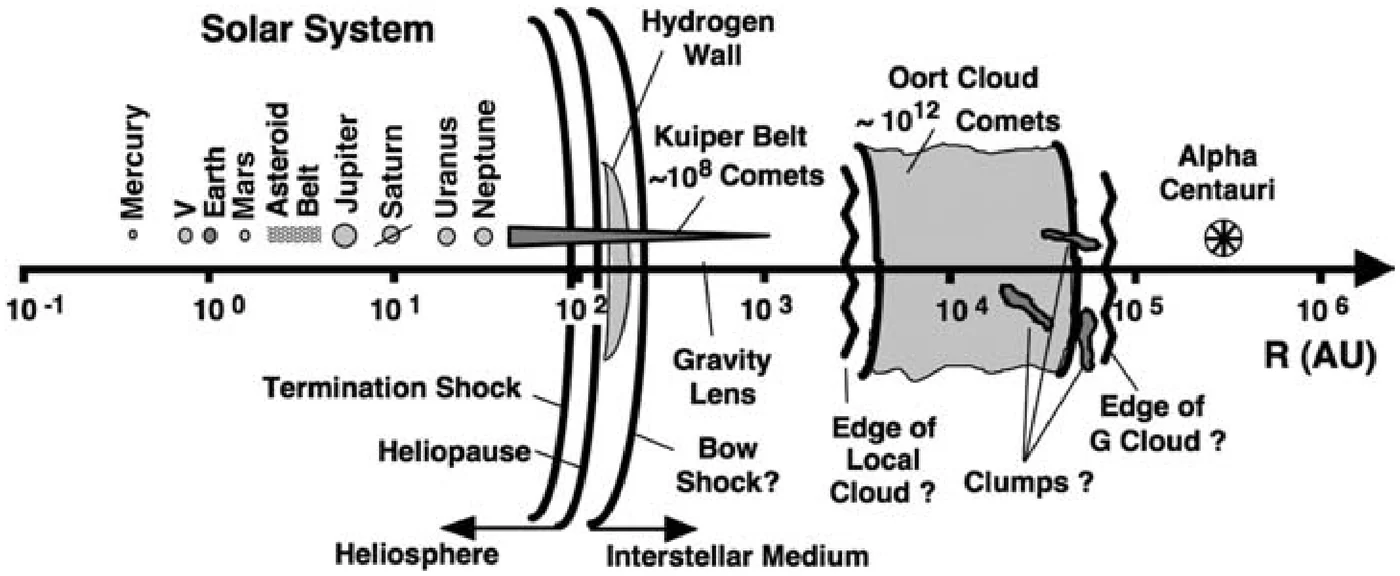
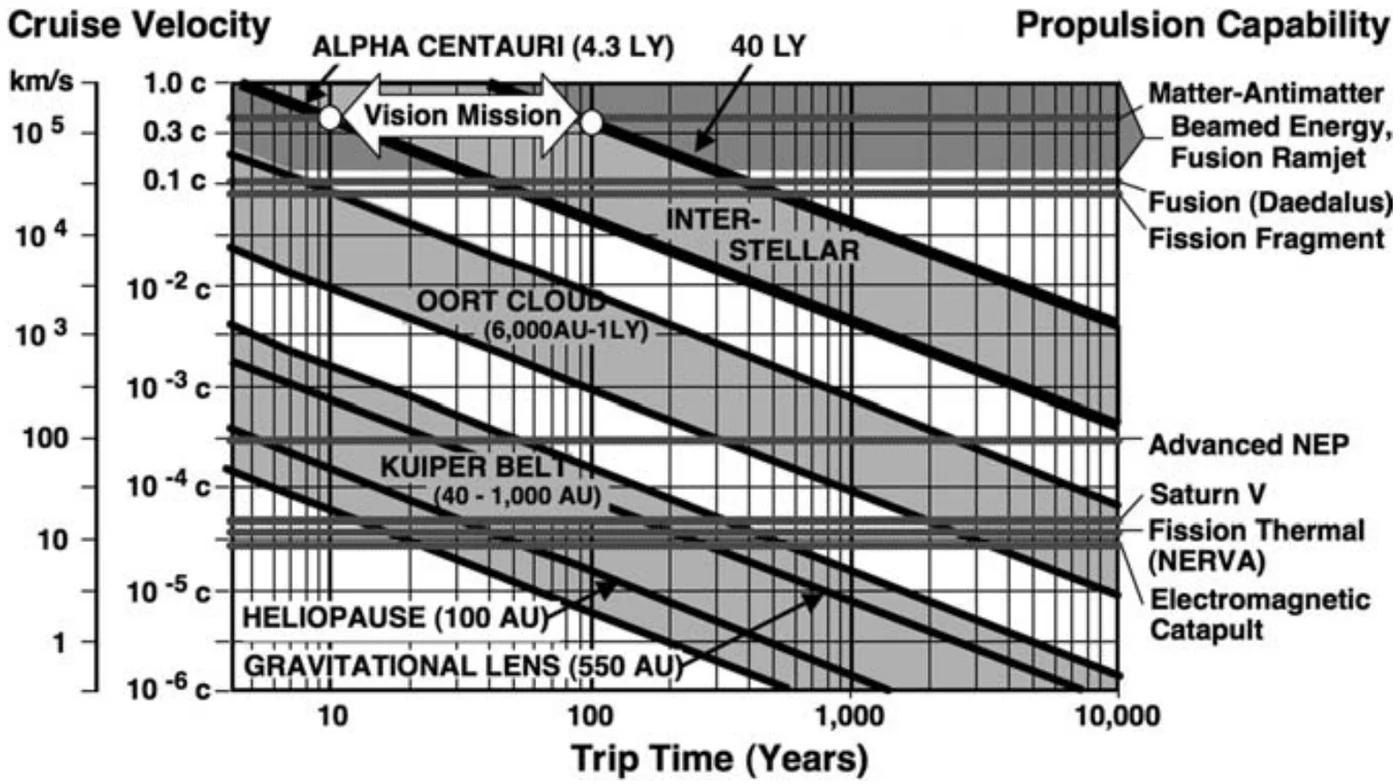
The distances are staggering and essentially incomprehensible. As to allow for some intuition, particularly when bumbling about in the below figure, consider the interior of the solar system and the more macroscopic structures of the universe. Within the solar system, the common unit of measure is the astronomical unit, the distance from the Sun to Earth. Earth is, then, \(1\,\mathrm{AU}\) from the sun; Neptune \(30\,\mathrm{AU}\); Voyager 1’s termination shock \(94\,\mathrm{AU}\)1; the heliopause \(122\,\mathrm{AU}\)2; the inner Oort cloud is thousands of AU; the outer edge of the Oort cloud of order \(10^5\,\mathrm{AU}\)4; and Alpha Centauri, the nearest star, \(\sim 2.7\times 10^5\,\mathrm{AU}\), or \(4.3\) light-years5. The smallest unit of measure in the star map below is essentially this distance (a few light years). Conversely, on larger scales than shown in the star map, the Milky Way galaxy is approximately \(10^5\) light-years in diameter38, the Andromeda galaxy about \(2.54\) million light-years away39, and the observable universe spans roughly \(93\) billion light-years40.
The map shows the intermediate scales, those interstellar destinations actually relevant save some wholescale reconception of physics. The Neighborhood are the named stars within 15 light-years. Named stars are those with a proper name (a historical name or IAU assigned name) or a Bayer–Flamsteed designation. Bayer designation is a Greek letter ranking brightness followed by the genitive of the constellation name. Flamsteed designation is a number within the constellation. HYG is the Hipparcos compilation, an ESA survey from the 1990s. AT-HYG is the Tycho-2 positions with Gaia DR3 distances of all stars brighter than apparent magnitude 10 within 100 light-years. Color is spectral type, or, if selected, ship time at the acceleration selected below. Clicking a letter on the spectral bar filters accordingly. Sun-centered locks the rotation on Sol; alternatively one can manipulate the rotation point using the six arrows. Clicking a star reveals its catalog facts and its duration away as a function of the choice of propulsion.
Sol
| Fuel | Reacted (energy only) | Carried (rocket eq.) | \(v_e\) |
|---|
For scale, the mass of the Earth is \(5.97 \times 10^{24}\,\mathrm{kg}\)41. The oceans hold roughly \(1.4 \times 10^{21}\,\mathrm{kg}\) of water.
Star positions: HYG v4.25; AT-HYG v4.0 (Tycho-2 + Gaia DR3)5. Planets: NASA Exoplanet Archive6. Map controls after Sutjijadi / Overview Effekt7. Turbo color: Mikhailov8. Fuel \(\varepsilon\) and \(\alpha\) from the table below10.
The calculations
Constant proper acceleration \(a\) over a laboratory distance \(x\) yields:
\[ \gamma = 1 + \frac{a x}{c^2}, \qquad \beta = \sqrt{1 - \gamma^{-2}}, \qquad \varphi = \mathrm{acosh}\,\gamma = \mathrm{artanh}\,\beta \] \[ \tau = \frac{c}{a}\,\mathrm{acosh}\,\gamma, \qquad t = \frac{c}{a}\sinh\frac{a\tau}{c} \]For a fly-by mission, the propulsion system operates over the whole distance \(D\). A flip-and-decelerate mission implies propulsion system operation over \((1-p)D/2\) each way and coasting a fraction \(p\) at peak \(\beta\). The mission rapidity is \(\Phi = N\varphi\) with \(N=1\) or \(2\). The characteristic \(\Delta v\) that enters the rocket equation is \(c\Phi\), and the coordinate peak speed is \(c\beta\).
The energy to change the dry mass’s kinetic energy \(E_{\Delta v}\) on each burn can be divided by conversion efficiency \(\eta\) to yield \(E_{\mathrm{in}}\). This efficiency \(\eta\) represents the fraction of theoretical reaction energy that is successfully converted into directed jet kinetic energy. The remainder is lost to isotropic radiation, unreacted fuel, or heating of the engine structure.
\[ E_{\Delta v} = N(\gamma-1)\,m_{\mathrm{dry}}c^2, \qquad E_{\mathrm{in}} = E_{\Delta v}/\eta \]\(m_{\mathrm{reacted}}\) is the mass that must react if that energy is provided by a fuel of energy density of \(\varepsilon\)
\[ m_{\mathrm{reacted}} = E_{\mathrm{in}} / \varepsilon \]If the same fuel is carried as propellant, the converted-mass fraction is \(\alpha = \varepsilon/c^2\). Efficiency scales it to \(\alpha_{\mathrm{eff}} = \eta\alpha\). Transferring that energy into the remaining rest mass as exhaust kinetic energy gives
\[ v_e = c\sqrt{\alpha_{\mathrm{eff}}(2-\alpha_{\mathrm{eff}})} \]Continuing to the multistage rocket equation, in Ackeret form. \(n\) equal stages split the rapidity, \(\Delta v = n\,v_e\ln(m_0/m_f)\):
\[ \frac{m_0}{m_{\mathrm{dry}}} = \exp\!\left(\frac{\Phi}{n}\frac{c}{v_e}\right), \qquad m_{\mathrm{carried}} = m_{\mathrm{dry}}\left(\frac{m_0}{m_{\mathrm{dry}}}-1\right). \]\(n=1\) represents a single stage. The carried column is \(\exp(\Phi c/(n v_e))\) times dry mass.
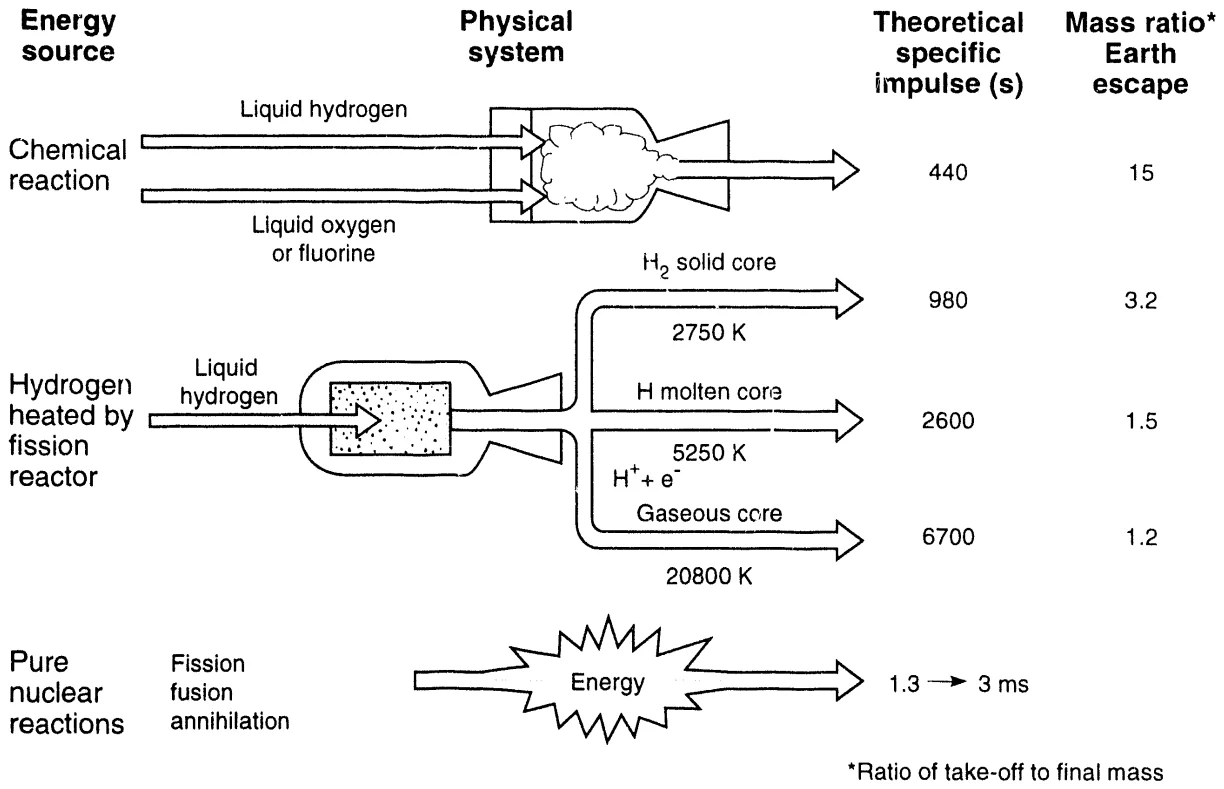
The map’s fuel rows are then derivative of \(\alpha=\varepsilon/c^2\) below. Values are from Borowski’s compilation10; the fuller table, with mixes and products, is in the next section.
| Fuel | \(\varepsilon\) (J/kg) | \(\alpha\) |
|---|---|---|
| LOX/LH\(_2\) | \(1.35\times 10^{7}\) | \(1.5\times 10^{-10}\) |
| \(^{235}\)U / \(^{239}\)Pu | \(8.2\times 10^{13}\) | \(9.1\times 10^{-4}\) |
| D–\(^{3}\)He | \(3.52\times 10^{14}\) | \(3.9\times 10^{-3}\) |
| p–\(^{11}\)B | \(7.32\times 10^{13}\) | \(8.1\times 10^{-4}\) |
| \(p\bar{p}\) | \(9.0\times 10^{16}\) | \(1\) |
Borowski, NASA TM-107030 / AIAA-87-1814, Table 1.10 \(\alpha=\varepsilon/c^2\). Mixes for the fusion rows are in the fuller table below.
Note that interstellar travel dictates large \(\Delta v\)s. Nonetheless, even travel within the solar system mandates \(\Delta v\)s of kilometers per second. Orbital radii are given by the semi-major axes (Pluto at perihelion)9. The table gives only the \(\Delta v\) required to enter the transfer, not to stop at the far end, and note that the last row, a one-light-year Hohmann transfer, would take \(2.8\) million years. Chemical rockets, then, can technically manage interstellar \(\Delta v\)s, but not at relevant travel times.
| Destination | Orbital radius (AU) | \(\Delta v\) to enter Hohmann orbit from Earth's orbit (km/s) | Transit time |
|---|---|---|---|
| Sun | 0 | 29.8 | 2.1 months |
| Mercury | 0.39 | 7.5 | 3.5 months |
| Venus | 0.72 | 2.5 | 4.8 months |
| Mars | 1.52 | 2.9 | 8.5 months |
| Jupiter | 5.2 | 8.8 | 2.7 years |
| Saturn | 9.54 | 10.3 | 6.0 years |
| Uranus | 19.19 | 11.3 | 16.0 years |
| Neptune | 30.07 | 11.7 | 30.6 years |
| Pluto | 29.66 (perih.) | 11.6 | 45.5 years |
| 1 light-year | 63,241 | 12.3 | 2.8 million years |
Here, the Hohmann transfers above are minimum energy, not minimum time.
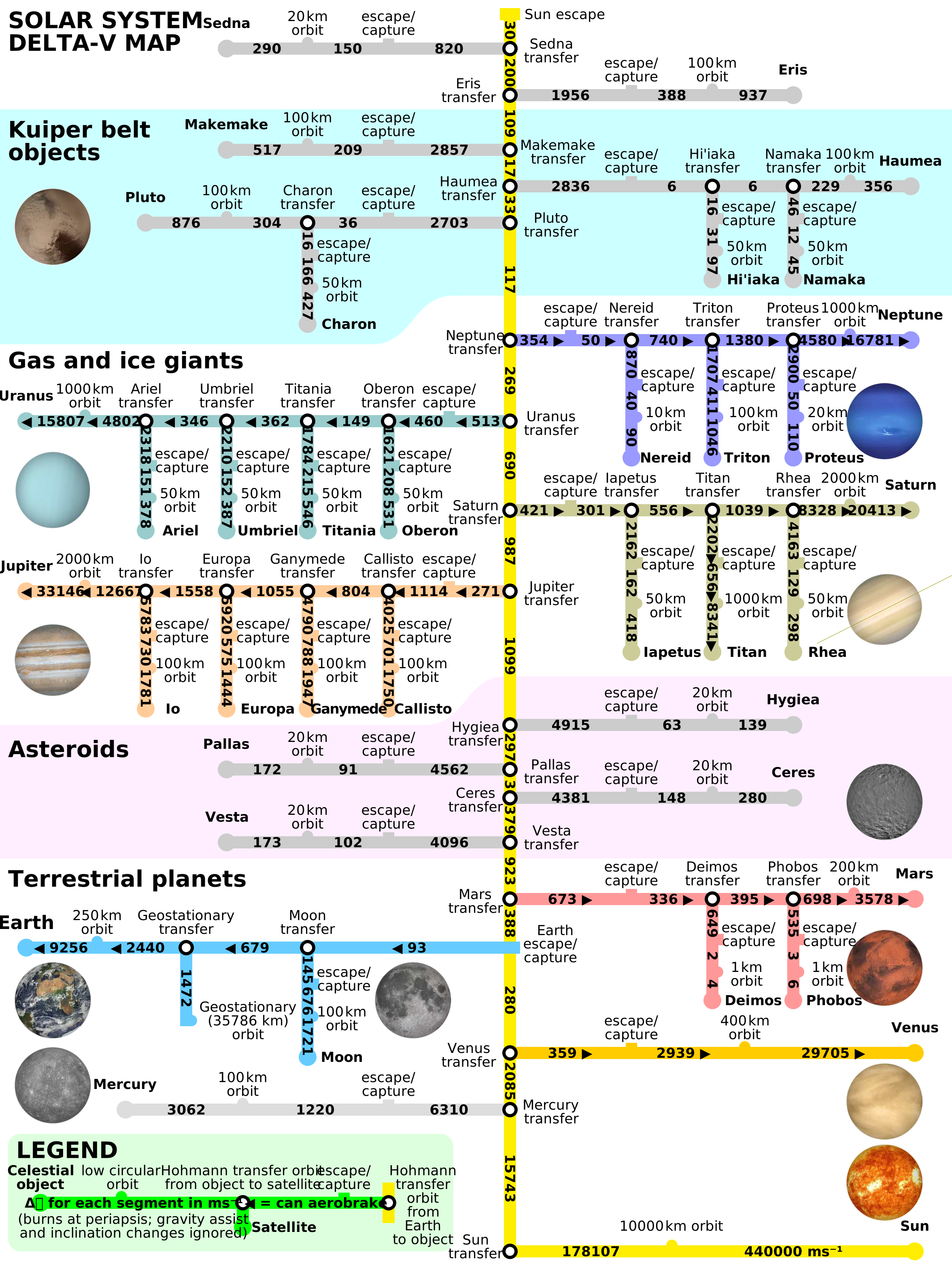
The table and the map are the same Hohmann burn. From a circular orbit of radius \(r_1\) (here Earth’s) to \(r_2\), the transfer ellipse has semi-major axis \(a=(r_1+r_2)/2\). The departure \(\Delta v\) is the difference between circular speed and perihelion speed on that ellipse; the transit is half an orbital period. Falling into the Sun is the degenerate case \(r_2\to 0\), \(a=r_1/2\).
\[ v_1=\sqrt{\mu/r_1},\qquad v_p=\sqrt{\mu\bigl(2/r_1-1/a\bigr)},\qquad \Delta v=\lvert v_p-v_1\rvert \] \[ t=\pi\sqrt{a^3/\mu} \]- \(r_2\)
- Earth circular
- \(\Delta v\) to enter
- Transit
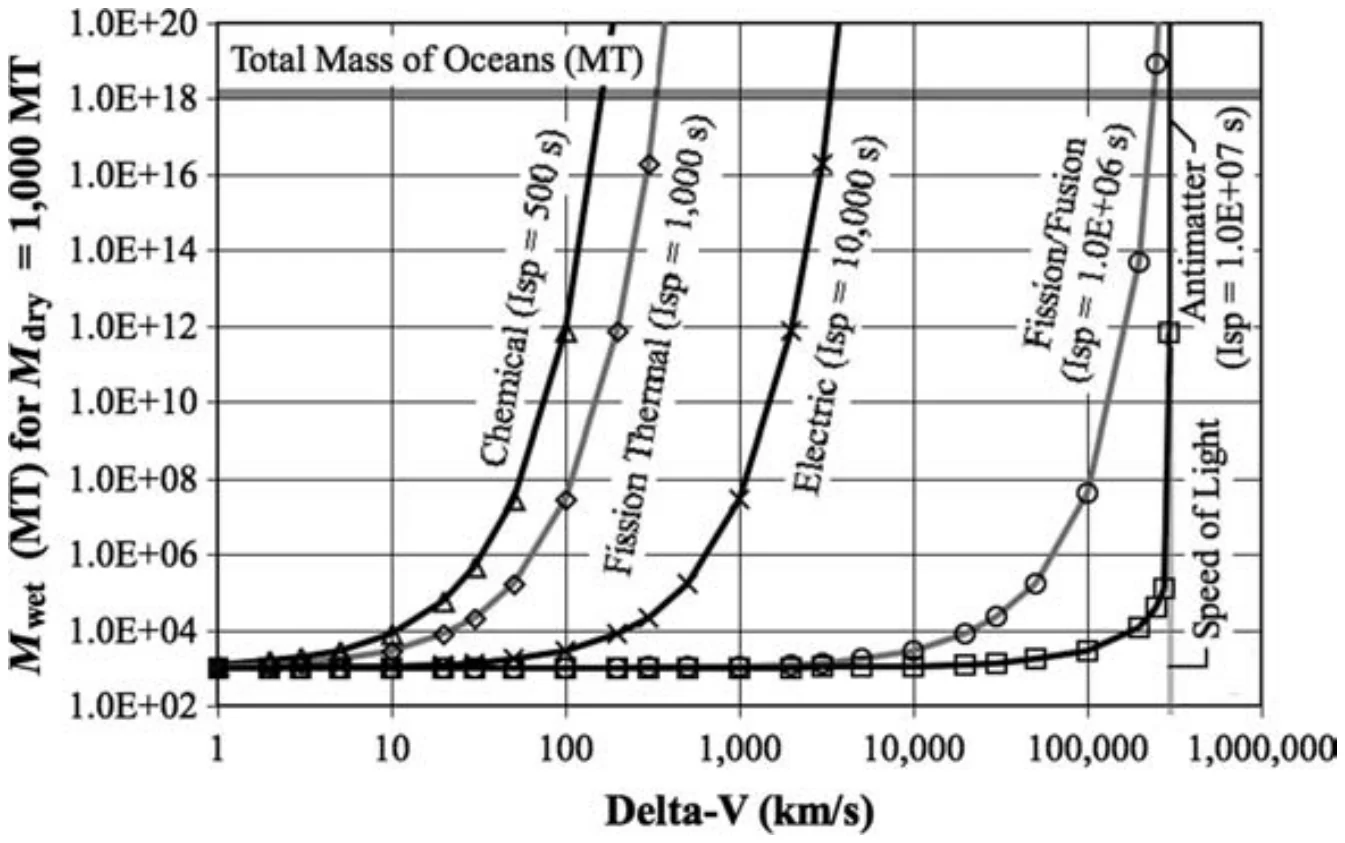
The tyranny of the rocket equation
A rocket expels mass in one direction in order to accelerate in the opposite direction. If the exhaust speed \(v_e\) is constant and the vehicle is not yet relativistic, Tsiolkovsky’s equation holds. For one stage, \(n=1\); \(n\) equal stages add that logarithm \(n\) times:
\[ \Delta v = n\, v_e \ln\left(\frac{m_0}{m_f}\right) = n\, I_{\mathrm{sp}} g_0 \ln\left(\frac{m_0}{m_f}\right) \]Specific impulse is the exhaust speed in units of seconds, \(I_{\mathrm{sp}} = v_e/g_0\). Inverting the log yields the mass ratio as an exponential of \(\Delta v/v_e\). Thus, sadly, each additional \(v_e\) of \(\Delta v\) multiplies the wet mass. \(n\) equal stages produce the same logarithm \(n\) times, \(\Delta v = n\,v_e\ln(m_0/m_f)\), so finding a given \(\Delta v\) requires solving for the \(n\)th root of the single-stage mass ratio. At speeds comparable to \(c\), conservation laws give the Ackeret form, which replaces \(\Delta v\) by a rapidity \(c\,\mathrm{artanh}(\Delta v/c)\):
\[ \Delta v = c\tanh\left(\frac{n v_e}{c}\ln\frac{m_0}{m_f}\right) = c\tanh\left(\frac{n I_{\mathrm{sp}} g_0}{c}\ln\frac{m_0}{m_f}\right) \]or, solved for the mass that must be loaded,
\[ \frac{m_0}{m_f} = \exp\left(\frac{\Delta v}{n\,I_{\mathrm{sp}} g_0}\right) = \exp\left(\frac{c\,\mathrm{artanh}(\Delta v/c)}{n\,I_{\mathrm{sp}} g_0}\right). \]When \(\Delta v \ll c\) the two expressions agree. When they do not, the relativistic one is less optimistic about \(\Delta v\) for a given mass ratio, and more expensive in mass for a given \(\Delta v\).11 A photon rocket (\(v_e = c\)) is the upper bound on \(I_{\mathrm{sp}}\), \(c/g_0 \simeq 3.06\times 10^7\,\mathrm{s}\).
What \(v_e\) you can buy is a question of how much of the propellant’s rest mass you are allowed to convert. Write the energy release per initial mass as \(\varepsilon = E/m_i = \alpha c^2\). Chemical bonds give \(\alpha \sim 10^{-10}\). Fission of \(^{235}\mathrm{U}\) or \(^{239}\mathrm{Pu}\) gives \(\alpha \sim 10^{-3}\). The better fusion mixes sit a little above that; proton–boron is worse than DT on energy per kilogram, and better on neutrons. Annihilation is \(\alpha = 1\).10
| Fuels | Reaction products | Energy release \(\varepsilon\) (J/kg) | Converted mass fraction \(\alpha\) |
|---|---|---|---|
| LOX/LH\(_2\) | water, hydrogen | \(1.35\times 10^{7}\) | \(1.5\times 10^{-10}\) |
| Atomic hydrogen | \(\mathrm{H}_2\) | \(2.18\times 10^{8}\) | \(2.4\times 10^{-9}\) |
| Metastable helium | \(^{4}\mathrm{He}\) | \(4.77\times 10^{8}\) | \(5.3\times 10^{-9}\) |
| \(^{233}\mathrm{U}\), \(^{235}\mathrm{U}\), \(^{239}\mathrm{Pu}\) | fission fragments, neutrons, \(\gamma\) | \(8.2\times 10^{13}\) | \(9.1\times 10^{-4}\) |
| DT (0.4/0.6) | helium, neutrons | \(3.38\times 10^{14}\) | \(3.75\times 10^{-3}\) |
| CAT-DD | hydrogen, helium, neutrons | \(3.45\times 10^{14}\) | \(3.84\times 10^{-3}\) |
| D–\(^{3}\mathrm{He}\) (0.4/0.6) | hydrogen, helium (some neutrons) | \(3.52\times 10^{14}\) | \(3.9\times 10^{-3}\) |
| p–\(^{11}\mathrm{B}\) (0.1/0.9) | helium | \(7.32\times 10^{13}\) | \(8.1\times 10^{-4}\) |
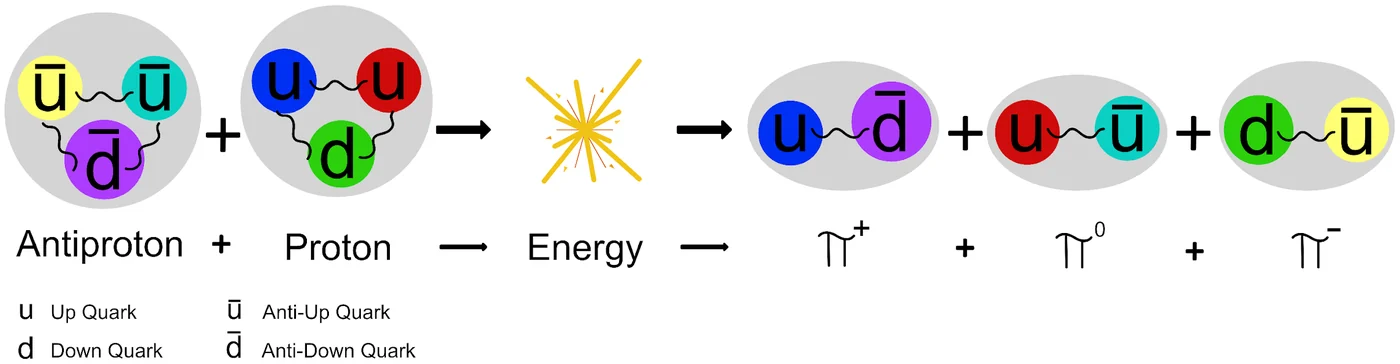
| \(p\bar{p}\) (0.5/0.5) | pions, muons, \(e^\pm\), neutrinos, \(\gamma\) | \(9\times 10^{16}\) | \(1.0\) |
Borowski, Table 1.10 Energy release \(\varepsilon\) and converted-mass fraction \(\alpha\). Fusion rows are mass mixes as written.
\(\alpha = (m_i - m_f)/m_i\). The fusion rows are mass mixes; CAT-DD burns the tritons and \(^{3}\mathrm{He}\) that DD produces. If that energy is put into the remaining rest mass as exhaust kinetic energy, \(v_e = c\sqrt{\alpha(2-\alpha)}\). That is the \(v_e\) the map uses, scaled by the efficiency slider.
- Engine
- Thrust
- \(I_{\mathrm{sp}}\)
- \(v_e\)
- \(P_{\mathrm{jet}}\)
- Engine
- Thrust
- \(I_{\mathrm{sp}}\)
- \(P_{\mathrm{jet}}\)
- C
- SCR/GCR
- ESI
- NP/MCF/ICF
- MAR
- \(\Delta v\)
- Chemical
- Fission thermal
- Electric
- Fusion
- Antimatter
- Distance
- Time
- Cruise
- Ideal \(I_{\mathrm{sp}}\)
- \(v_e\)
- Mass ratio
References
- E. C. Stone et al., “Voyager 1 Explores the Termination Shock Region and the Heliosheath Beyond,” Science 309, 2017 (2005). Crossed 16 Dec 2004 at 94.01 AU. doi:10.1126/science.1117684
- D. A. Gurnett et al., “In Situ Observations of Interstellar Plasma with Voyager 1,” Science 341, 1489 (2013). Heliopause 25 Aug 2012 at \(\sim 122\) AU. doi:10.1126/science.1241681
- V. R. Eshleman, “Gravitational Lens of the Sun: Its Potential for Observations and Communications over Interstellar Distances,” Science 205, 1133 (1979). Focal line begins at about 550 AU. doi:10.1126/science.205.4411.1133. Later engineering numbers use 547.6–548 AU: S. G. Turyshev et al., NASA NIAC Phase I final report (2018), NTRS 20180006788.
- J. H. Oort, “The structure of the cloud of comets surrounding the Solar System and a hypothesis concerning its origin,” Bull. Astron. Inst. Neth. 11, 91 (1950). ADS 1950BAN....11...91O; PDF.
- Astronomy Nexus, HYG Database v4.2 (Hipparcos, Yale Bright Star Catalog, Gliese) and AT-HYG v4.0 (Tycho-2 + Gaia DR3). The map’s AT-HYG cut is the mag-10 subset plus every star within 100 ly (~3.3\times105 stars). CC BY-SA 4.0. astronexus.com/projects/hyg; astronexus.com/projects/at-hyg.
- NASA Exoplanet Archive, Planetary Systems Composite Parameters (PSCompPars). exoplanetarchive.ipac.caltech.edu. Host placement follows NASA Eyes on Exoplanets.
- K. Sutjijadi, Interstellar Map (MIT). github.com/kevinsutjijadi/interstellarmap. Relativistic travel formulae as used by Overview Effekt.
- A. Mikhailov, “Turbo, An Improved Rainbow Colormap for Visualization,” Google Research (2019). research.google/blog/turbo-an-improved-rainbow-colormap-for-visualization.
- NASA NSSDC planetary fact sheets (orbital radii; Earth escape \(\sim 11.2\,\mathrm{km\,s^{-1}}\)). nssdc.gsfc.nasa.gov/planetary/factsheet. Hohmann \(\Delta v\) and times in the table are vis-viva with \(\mu_\odot\) from those constants, not published mission \(\Delta v\).
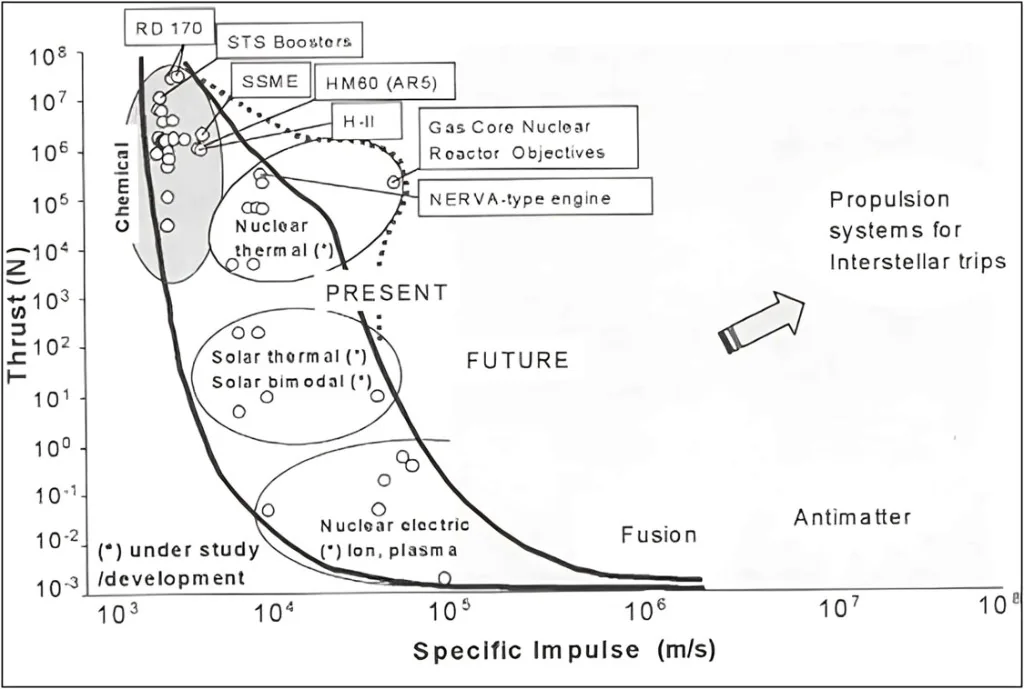
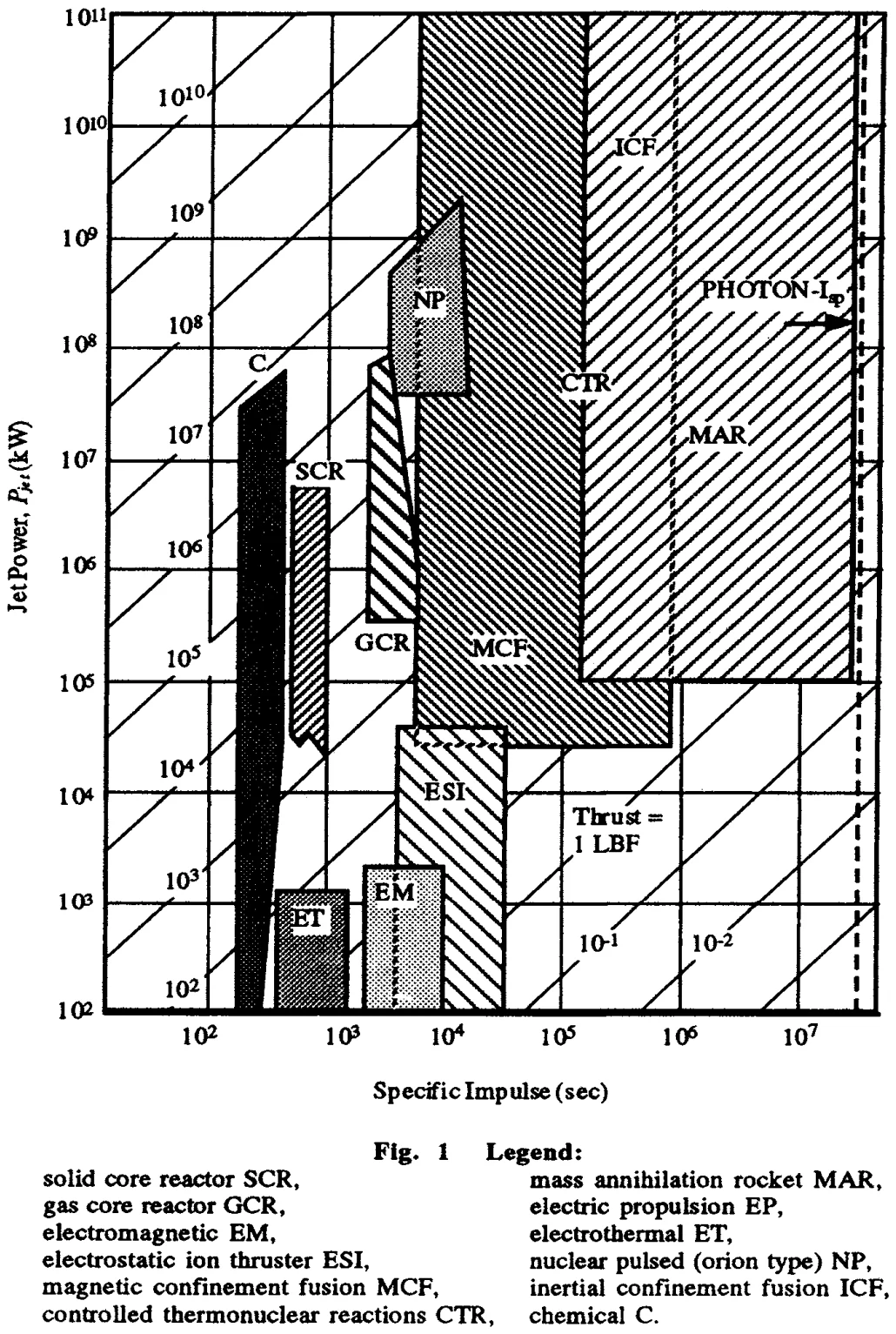
- S. K. Borowski, “Comparison of Fusion/Antiproton Propulsion Systems for Interplanetary Travel,” NASA TM-107030 / AIAA-87-1814 (1987). Table 1 is the \(\varepsilon\) and \(\alpha\) compilation (LOX/LH2 \(1.35\times 10^7\) J/kg, fission \(8.2\times 10^{13}\), DT / CAT-DD / D–3He / p–11B, \(p\bar{p}\) \(9\times 10^{16}\), \(\alpha=1\)). Fig. 1 is the \(P_{\mathrm{jet}}\)–\(I_{\mathrm{sp}}\) islands (C, SCR, GCR, ESI, NP, MCF, ICF, MAR). Antimatter production discussion cites Howe: future \(\eta\sim 2.5\times 10^{-4}\), \(\sim\$10^{10}/\mathrm{g}\). Open PDF: projectrho.com … ComparisonFusionAntiproton.pdf. AIAA: doi:10.2514/6.1987-1814.
- J. Ackeret, “Zur Theorie der Raketen,” Helv. Phys. Acta 19, 103 (1946). Relativistic rocket equation. doi:10.5169/seals-111699.
- M. A. Charette and W. H. F. Smith, “The Volume of Earth’s Ocean,” Oceanography 23(2), 112 (2010). Volume \(1.332\times 10^9\,\mathrm{km}^3\); times \(\sim 1025\,\mathrm{kg\,m^{-3}}\) is \(1.37\times 10^{21}\,\mathrm{kg}\). The plot uses \(1.4\times 10^{21}\,\mathrm{kg}\) as a round ocean mass. doi:10.5670/oceanog.2010.51.
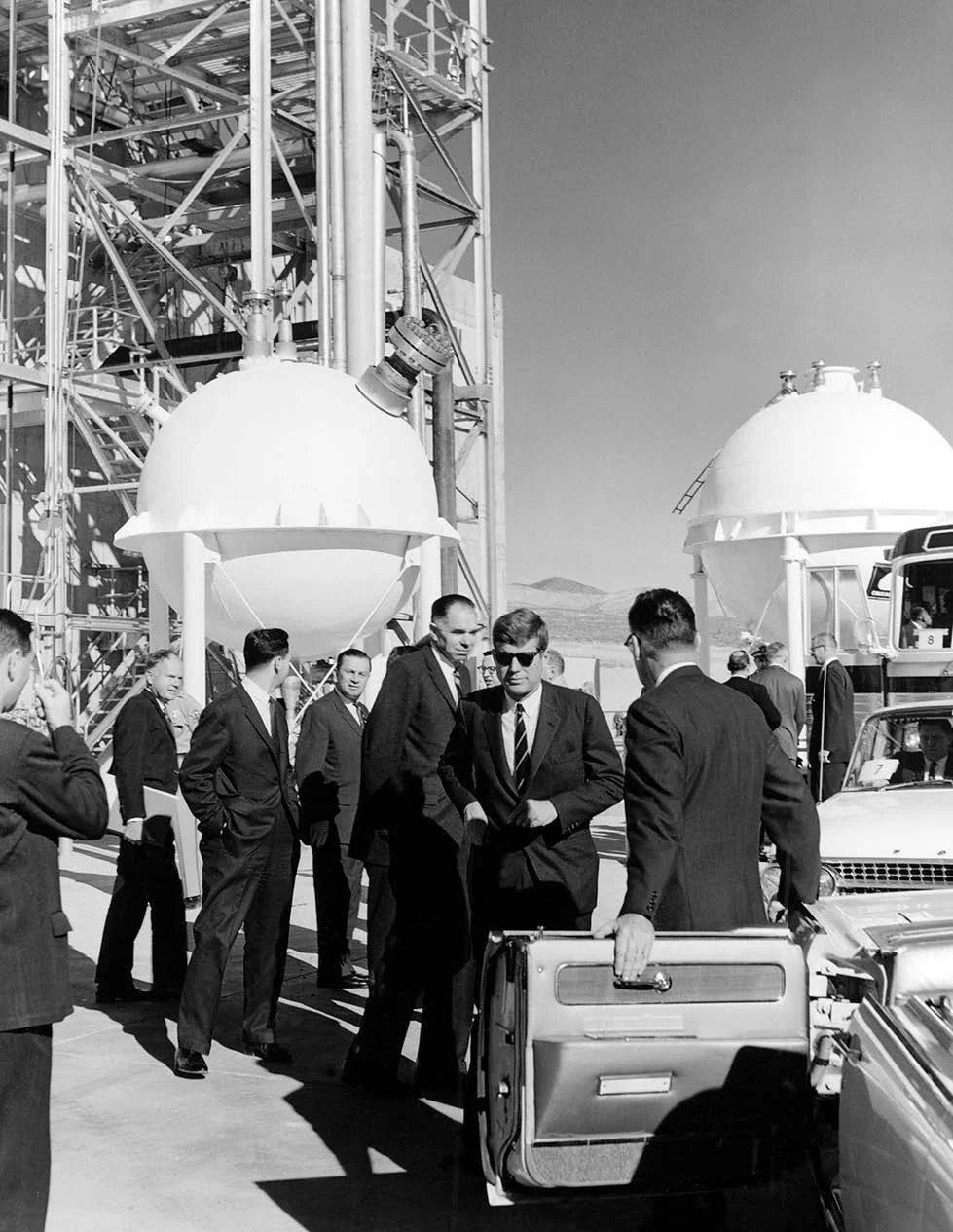
- John F. Kennedy, Special Message to the Congress on Urgent National Needs, 25 May 1961. Moon goal and Rover nuclear-rocket funding. JFK Library transcript.
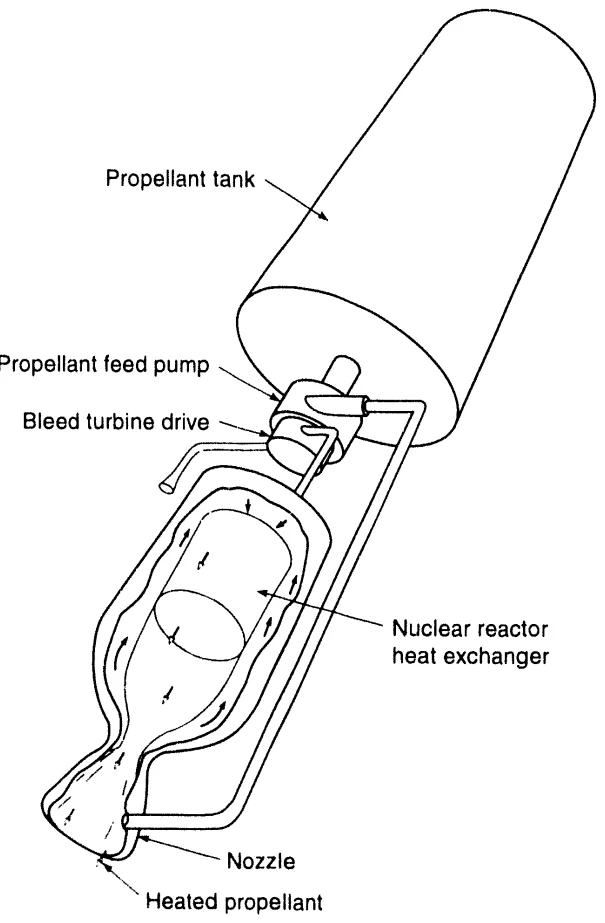
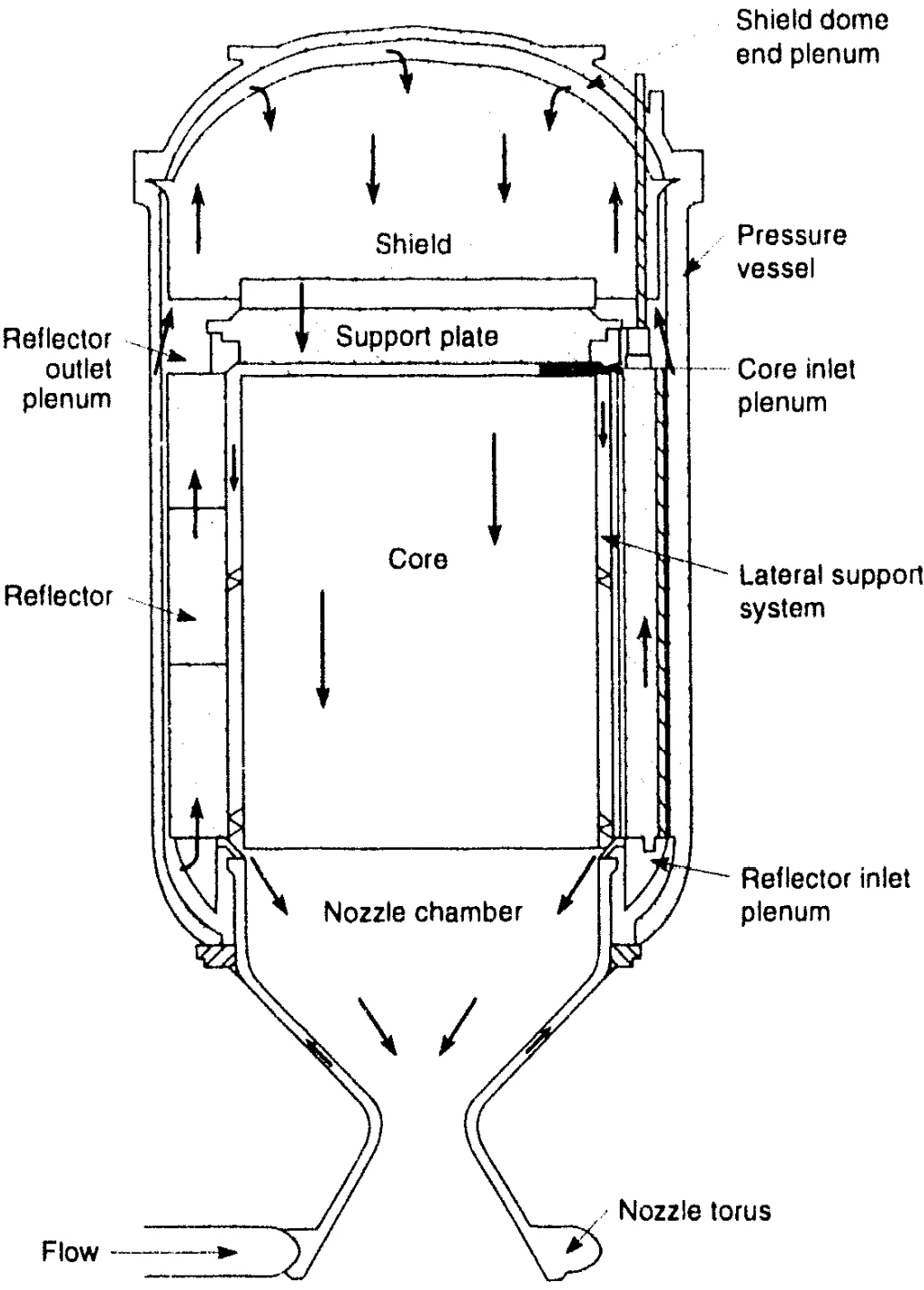
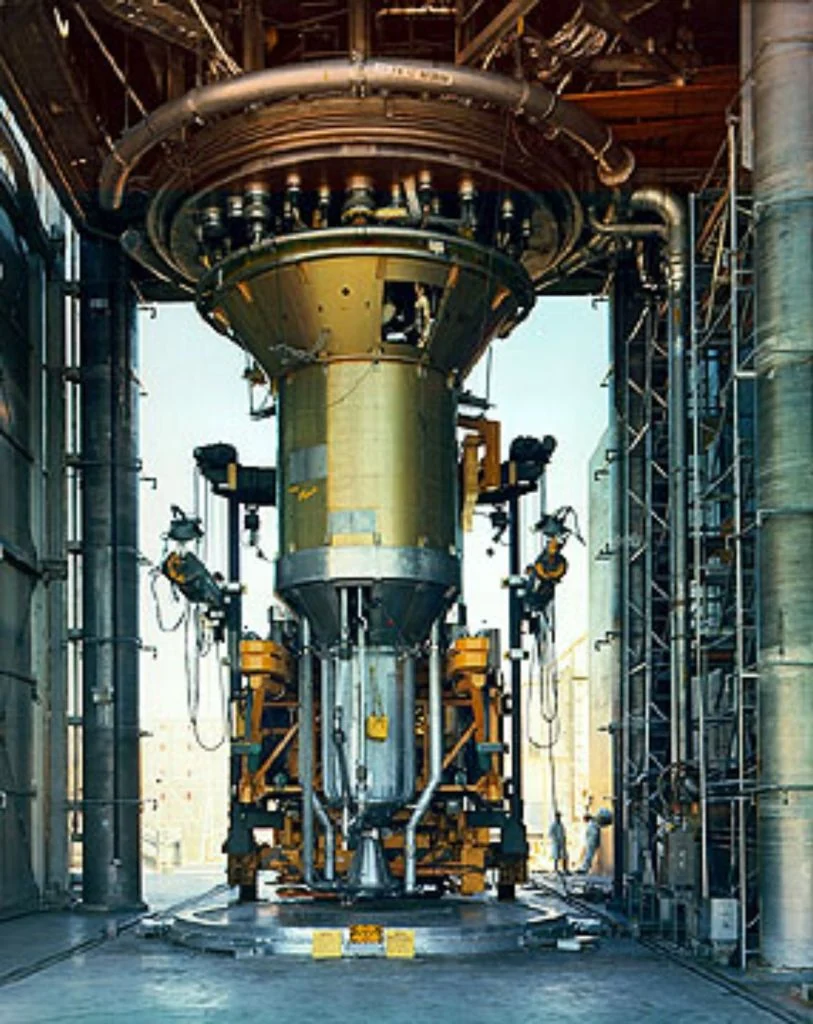
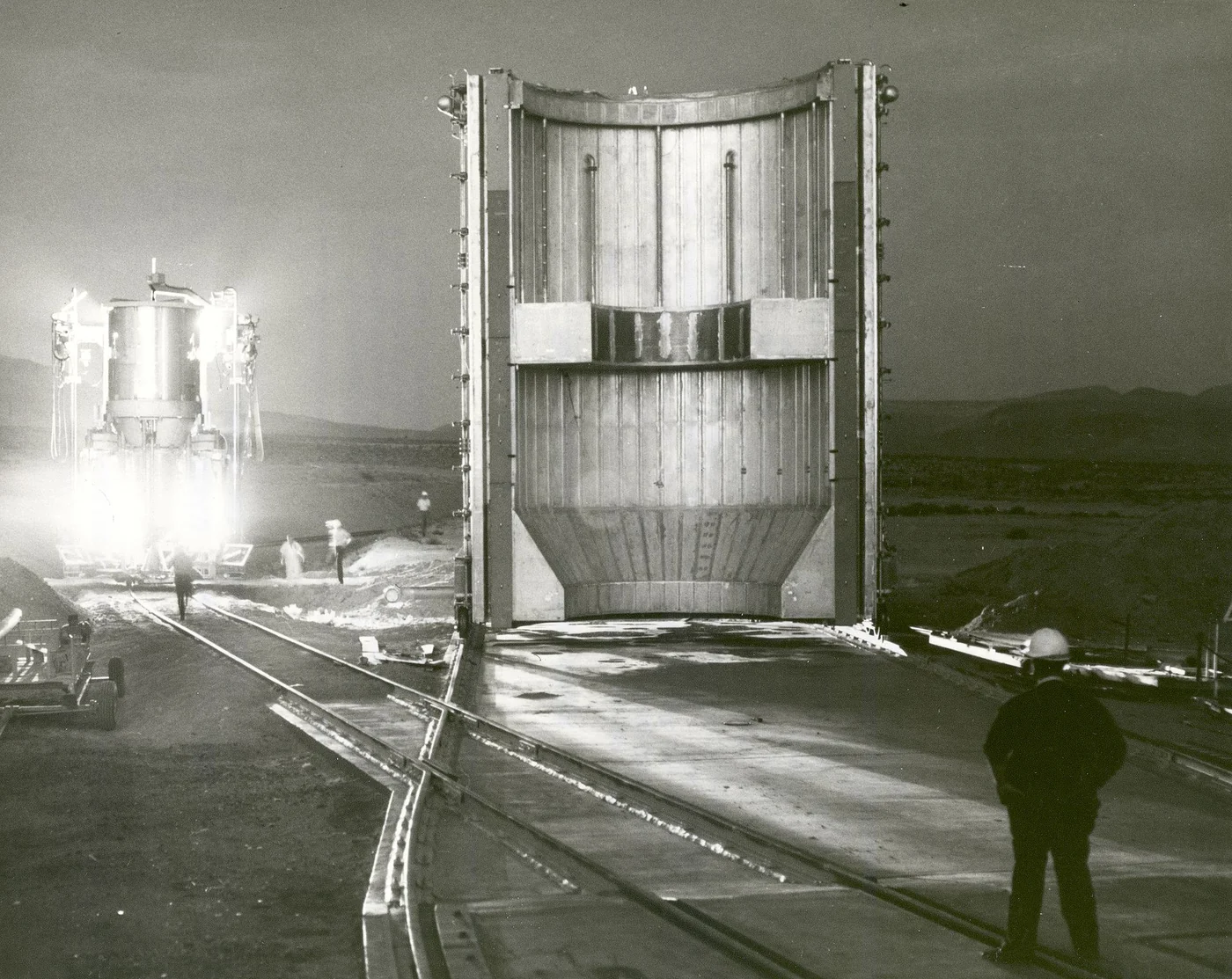
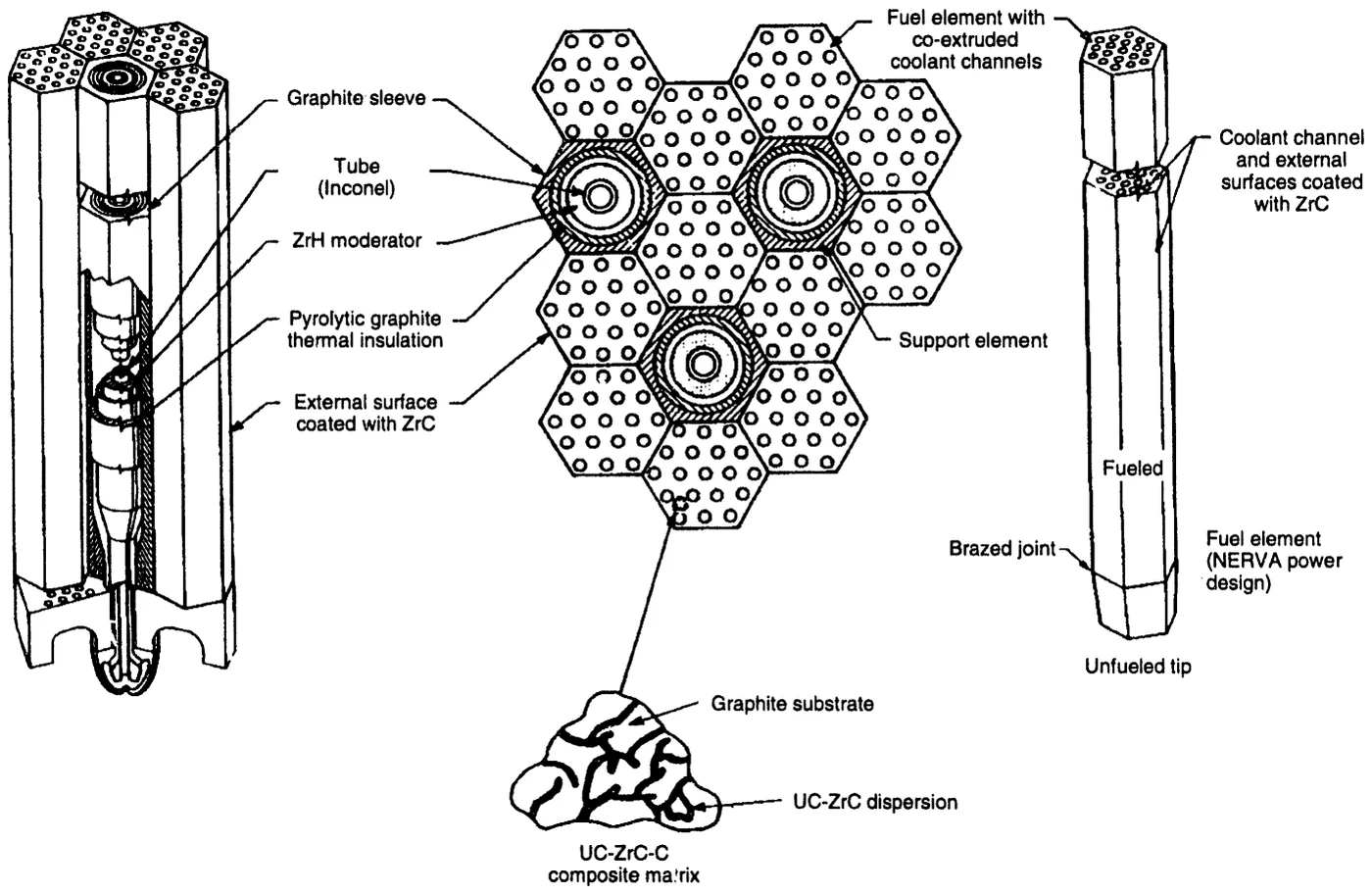
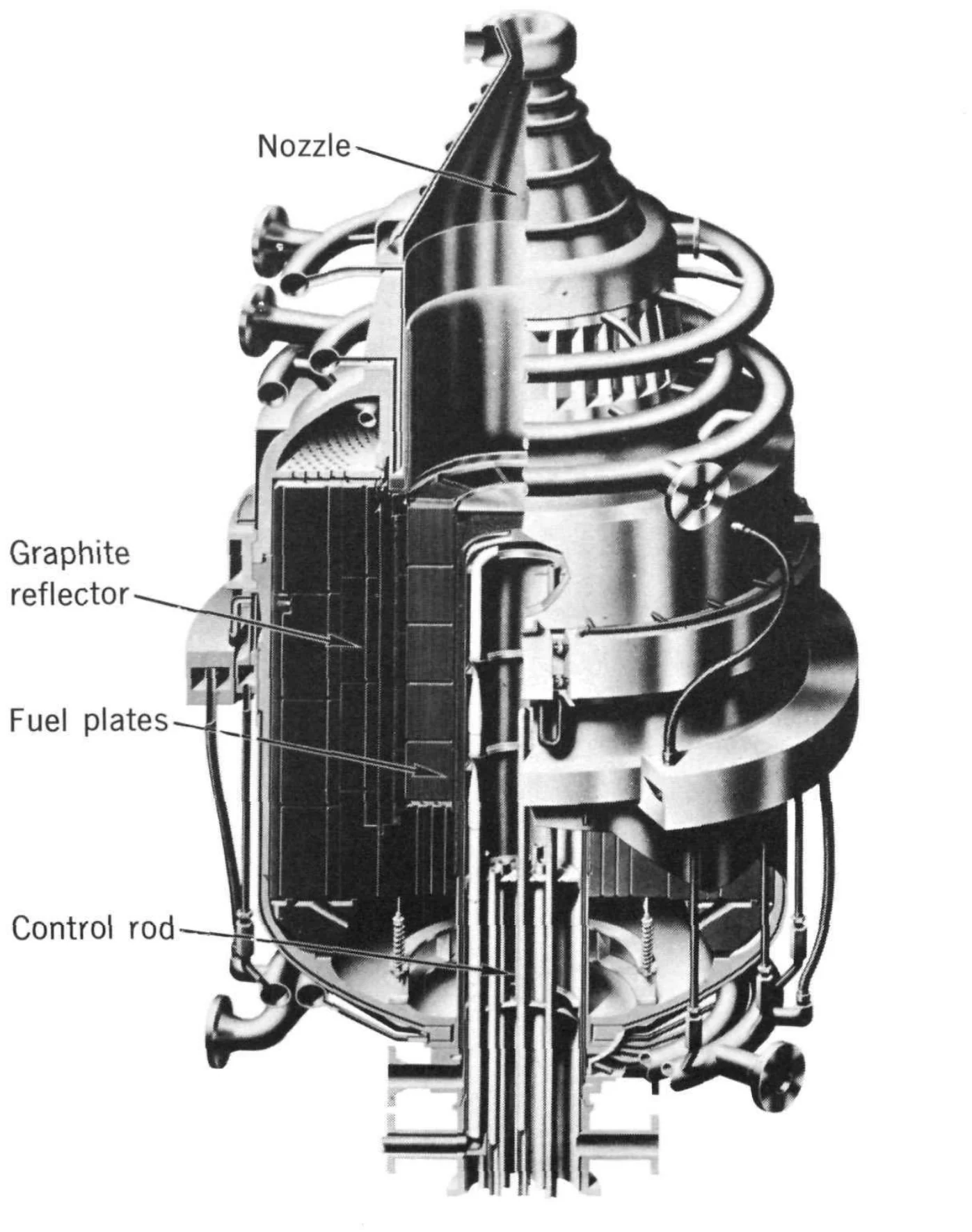
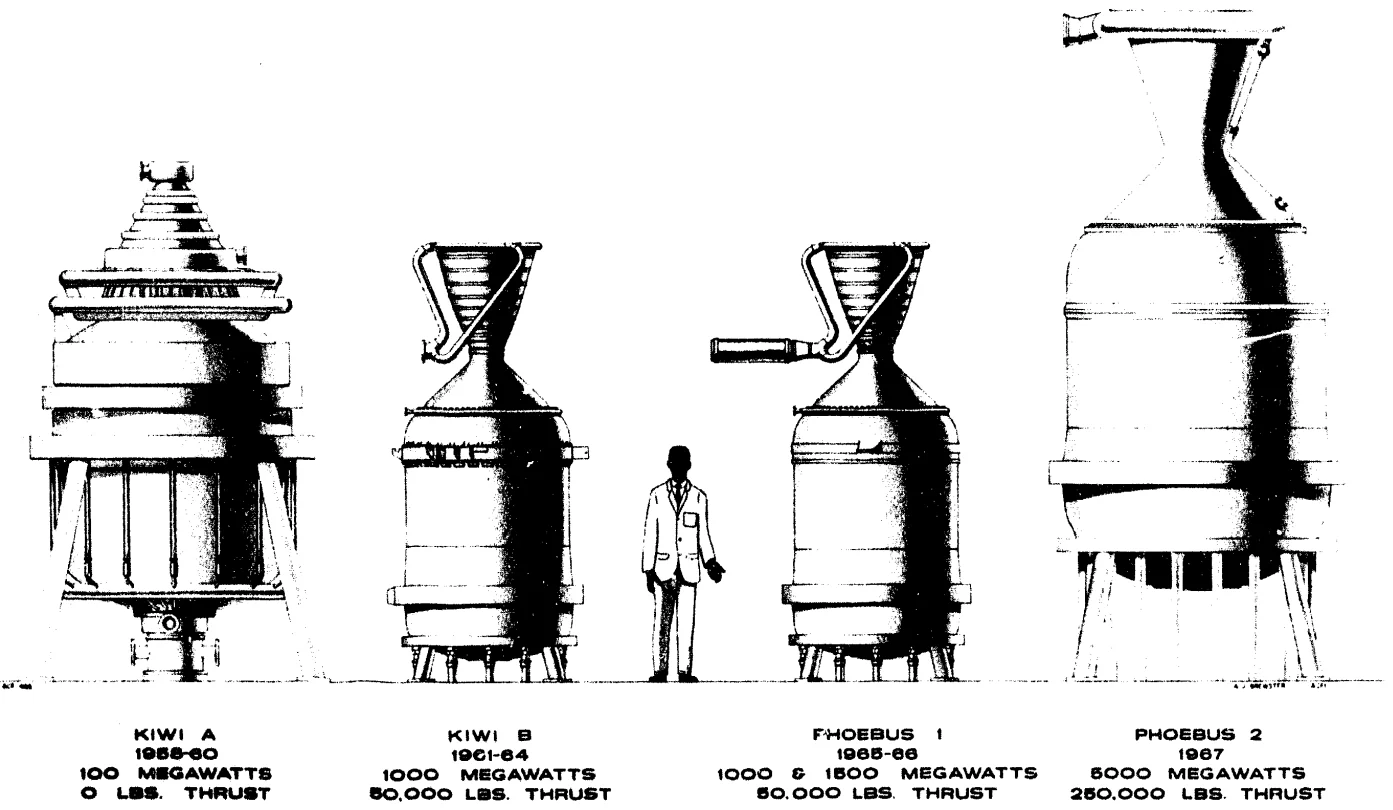
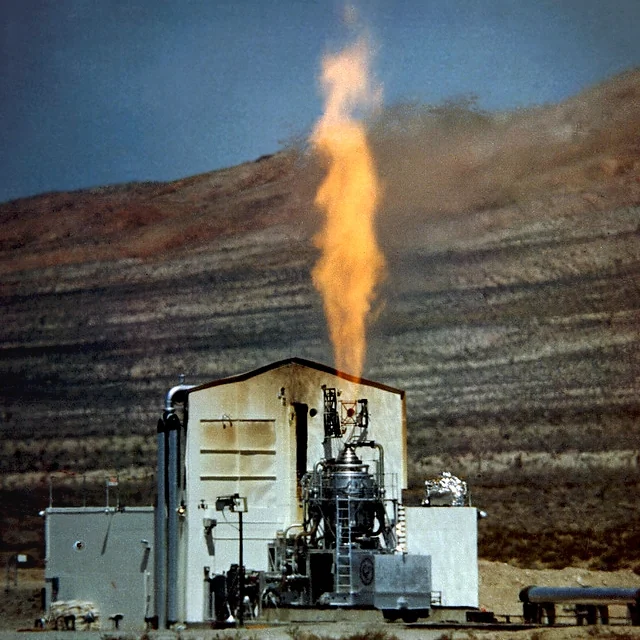
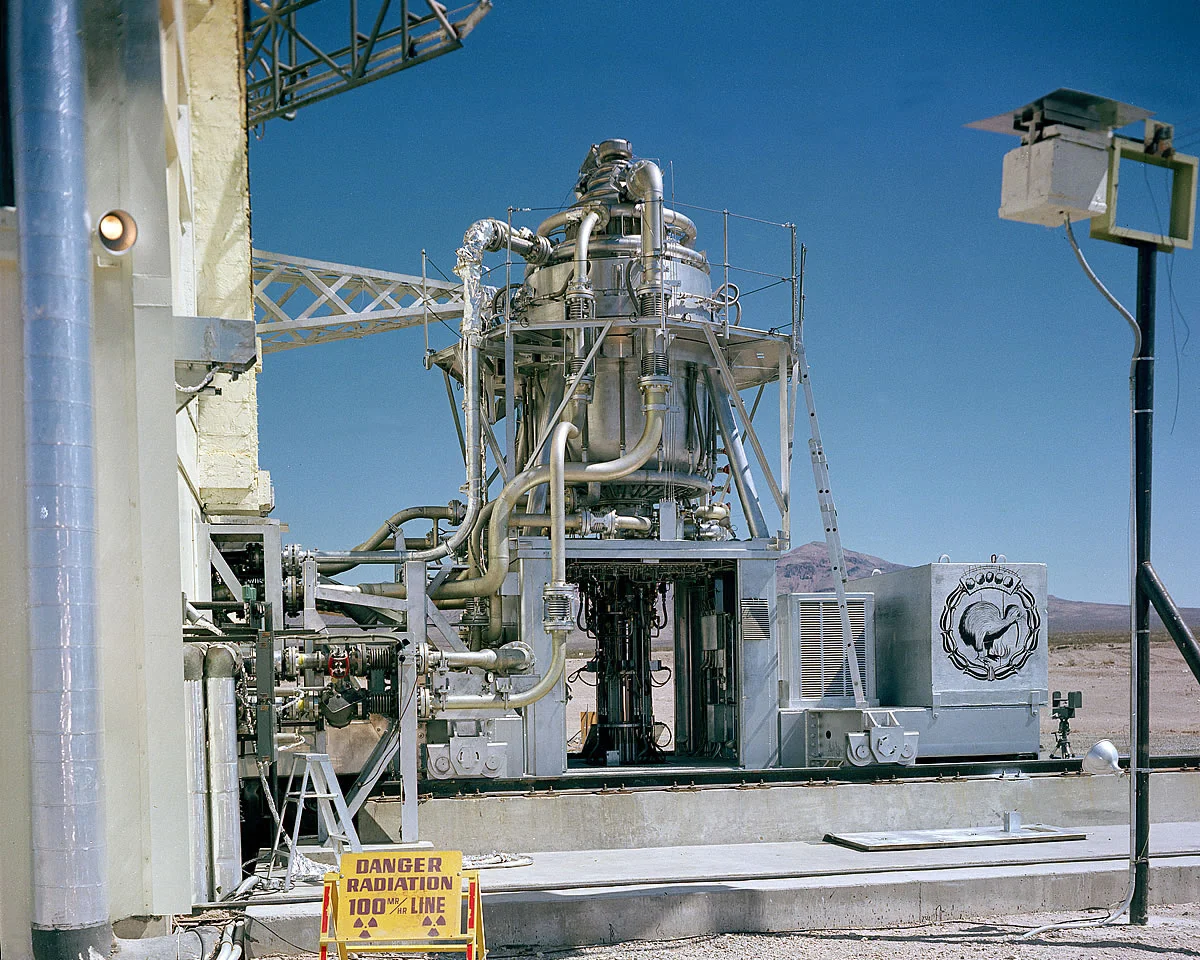
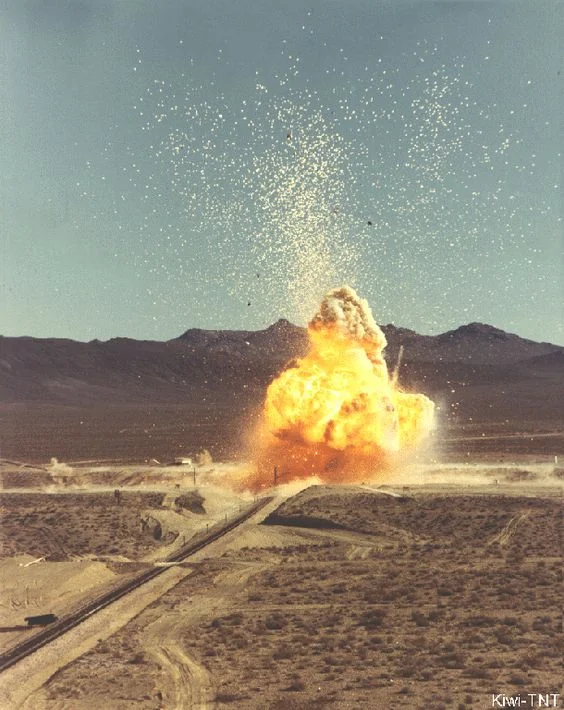
- NASA photographs, Nuclear Rocket Development Station, Jackass Flats. NERVA on ETS-1: NASA Commons / Flickr. Kiwi-TNT, 12 Jan 1965, NASA GPN-2002-000145: Wikimedia.
- J. L. Finseth, “Rover nuclear rocket engine program: Overview of rover engine tests,” NASA CR-184270 (1991). XE-Prime \(244\,750\,\mathrm{N}\) (\(55\,000\,\mathrm{lbf}\)); NRX-class \(I_{\mathrm{sp}}\) \(>841\,\mathrm{s}\). The chart’s NERVA XE point is \(2.47\times 10^5\,\mathrm{N}\), \(850\,\mathrm{s}\). NTRS 19920005899; PDF.
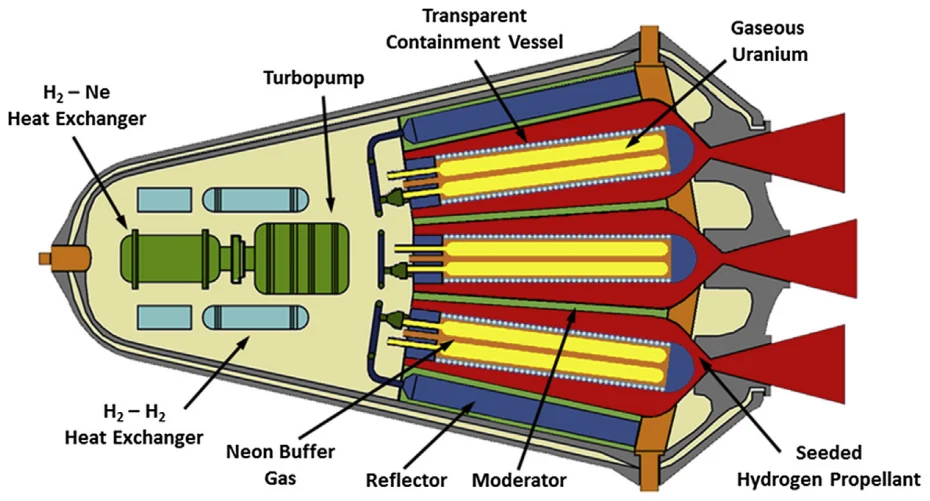
- G. H. McLafferty and H. E. Bauer, “Studies of specific nuclear light bulb and open-cycle vortex-stabilized gaseous nuclear rocket engines,” NASA CR-1030 (1968). NTRS 19680012569; PDF.
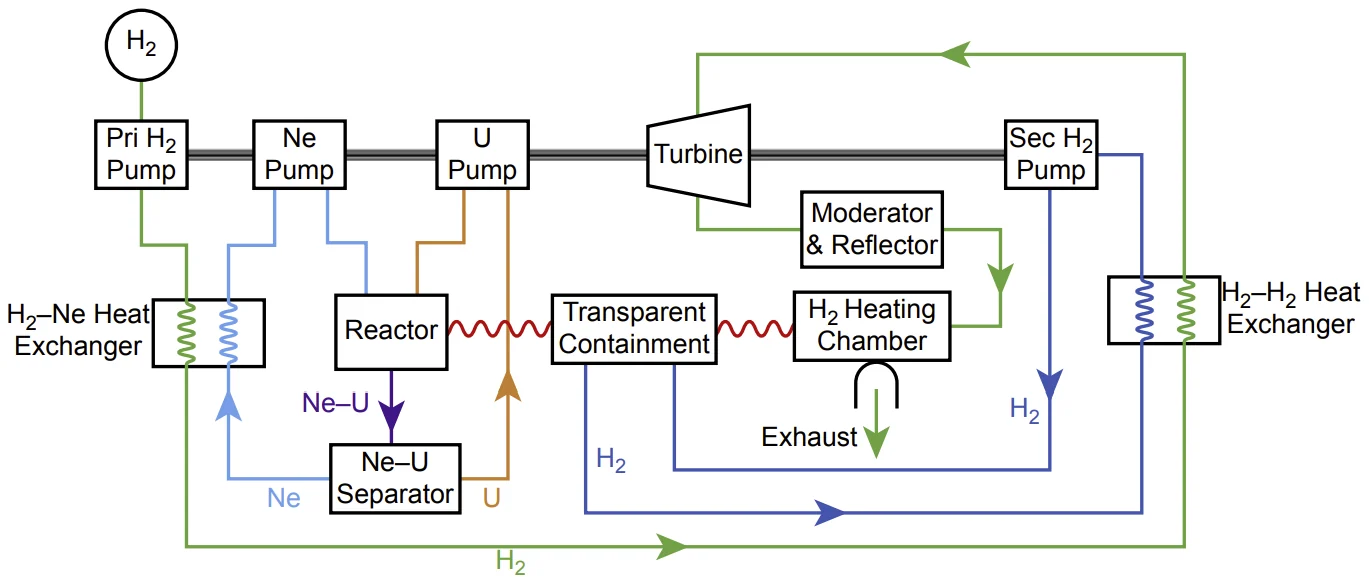
- T. Latham, “Nuclear light bulb,” in Nuclear Thermal Propulsion: A Joint NASA/DOE/DOD Workshop (1991). NTRS 19920001892.
- F. J. Dyson, “Interstellar Transport,” Physics Today 21(10), 41 (1968). Project Orion. doi:10.1063/1.3034534.
- A. Bond, A. R. Martin, et al., “Project Daedalus — The Final Report on the BIS Starship Study,” J. Br. Interplanet. Soc. Supplement (1978). ADS 1978JBIS...31S...5B; BIS note: bis-space.com/technical-projects. Chart “Daedalus I” uses \(7.54\times 10^5\,\mathrm{N}\), \(10^6\,\mathrm{s}\); Bond’s first stage is closer to \(7.5\,\mathrm{MN}\).
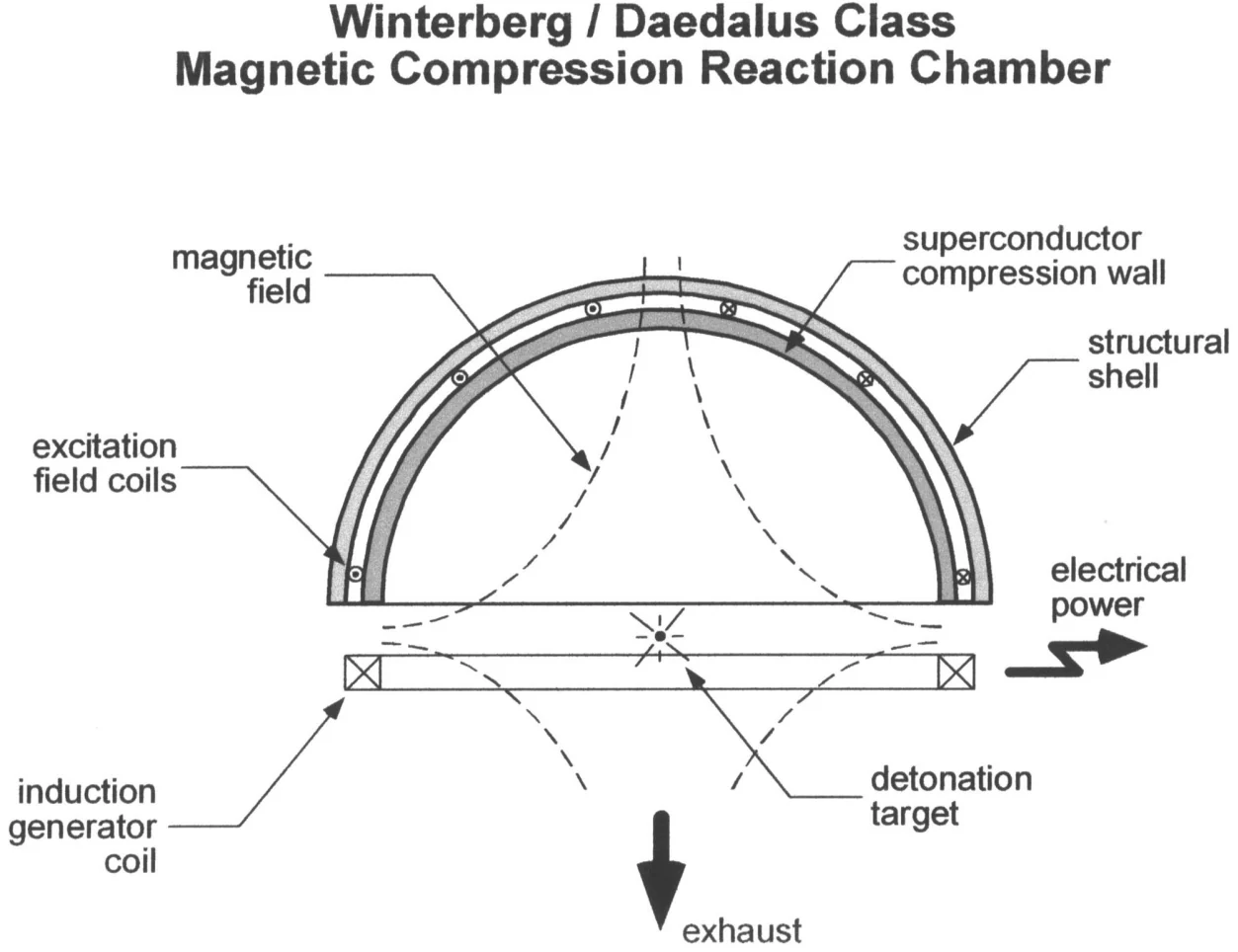
- F. Winterberg, “Rocket propulsion by thermonuclear micro-bombs ignited with intense relativistic electron beams,” Raumfahrtforschung 15, 208 (1971). NTRS 19720027556.
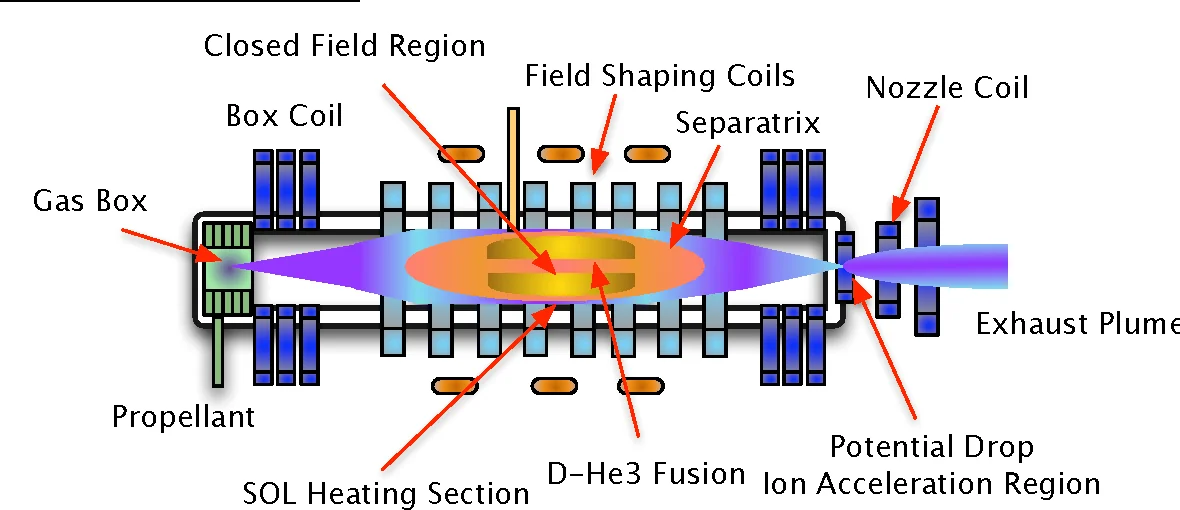
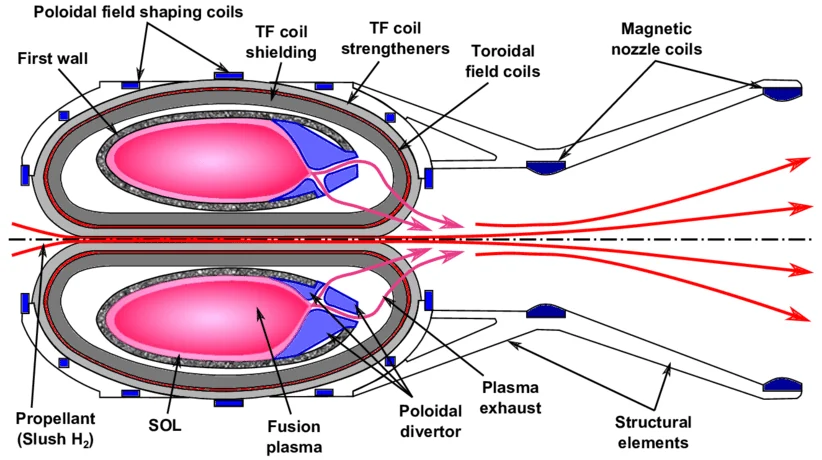
- Y. S. Razin et al., “A direct fusion drive for rocket propulsion,” Acta Astronautica 105, 145 (2014). doi:10.1016/j.actaastro.2014.08.008. Program page: psatellite.com/technology/fusion.
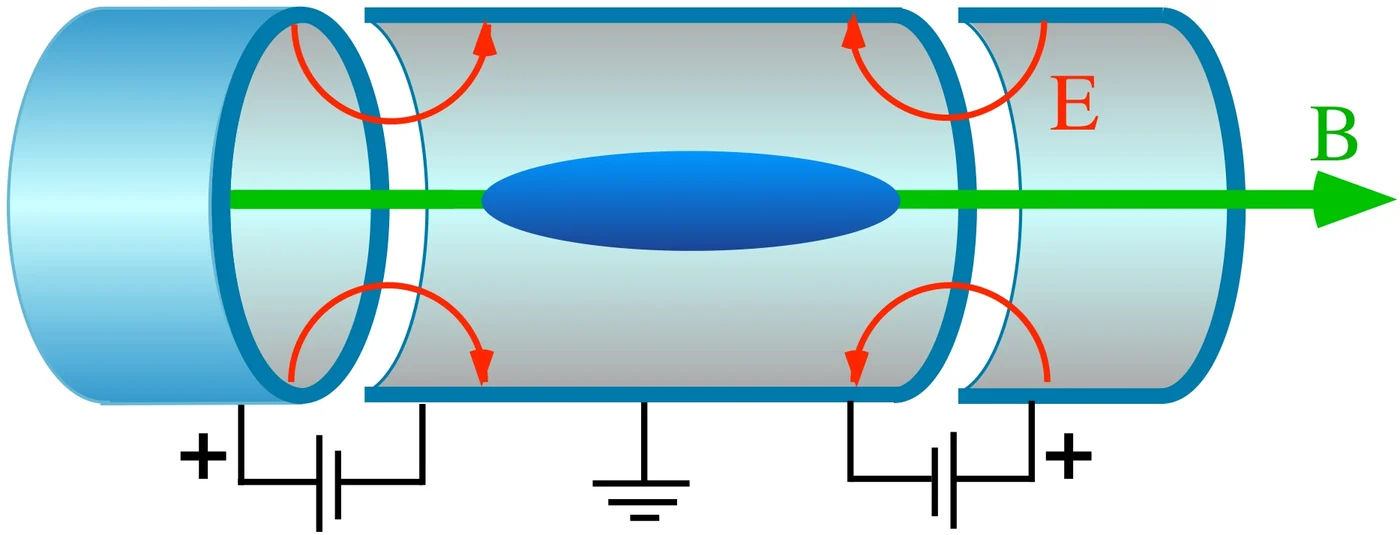
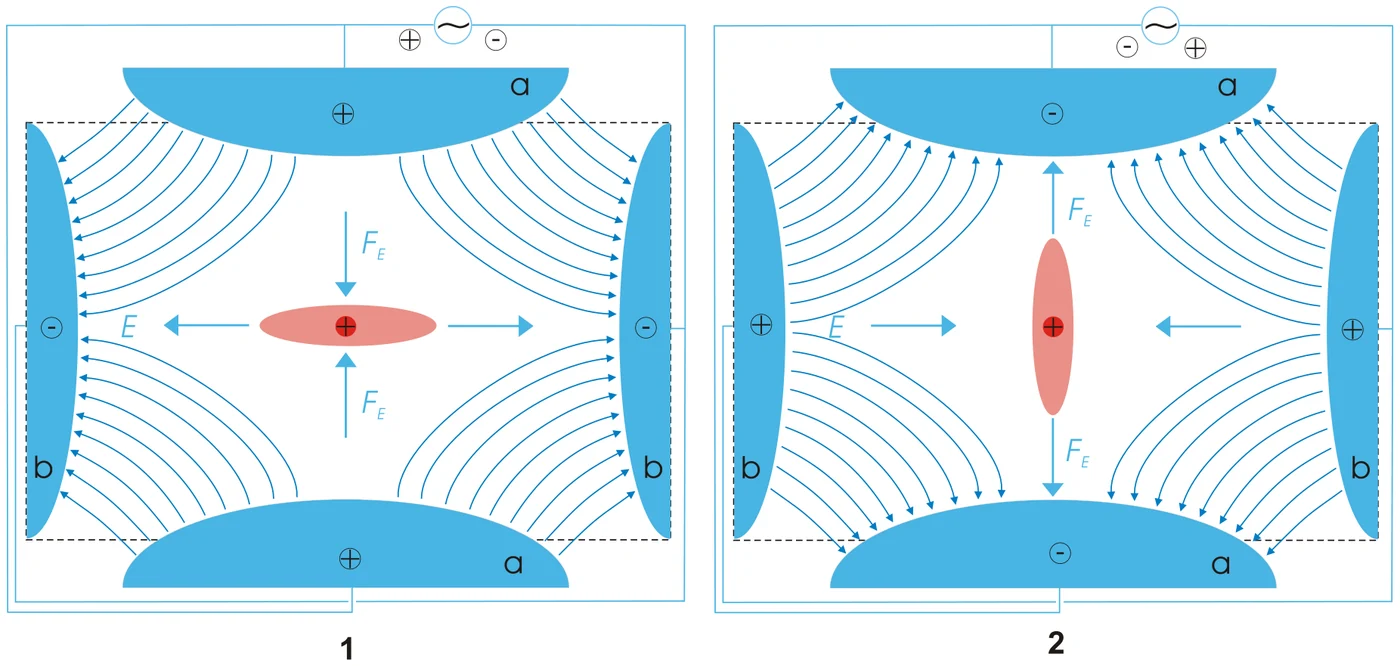
- CERN ALPHA experiment (antihydrogen traps). alpha.web.cern.ch.
- NASA, RS-25 engine (SSME): vacuum thrust \(\sim 2.28\,\mathrm{MN}\), \(I_{\mathrm{sp}}\sim 452\,\mathrm{s}\). nasa.gov/reference/rs-25-engine.
- M. J. Patterson and S. W. Benson, “NEXT Ion Propulsion System Development Status and Performance,” NASA/TM-2008-214986 (2008). NEXT \(\sim 236\,\mathrm{mN}\), \(>4100\,\mathrm{s}\). NTRS 20080010688. NSTAR on Deep Space 1: \(\sim 92\,\mathrm{mN}\), \(\sim 3100\,\mathrm{s}\). NASA DS1.
- B. W. Longmier et al., “VX-200 Magnetoplasma Thruster Performance Results Exceeding Fifty-Percent Thruster Efficiency,” J. Propulsion and Power 27, 915 (2011). VASIMR VX-200 \(\sim 5\,\mathrm{N}\) class, \(I_{\mathrm{sp}}\) thousands of seconds. doi:10.2514/1.B34173.
- T. H. Rider, “Fundamental Constraints on Large-Scale Antimatter Rocket Propulsion,” J. Propulsion and Power 13, 435 (1997). Beam–target \(\eta = 2.2\times 10^{-4}\); colliding-nucleon bound \(\eta \simeq 2.3\times 10^{-3}\); Eqs. (1)–(2) are the \(9.0\times 10^{16}/\eta\,\mathrm{J/kg}\) and \(\$1.5\,\text{billion}/(\eta\,\mathrm{kg})\) bills at \(\$0.06/\mathrm{kWh}\); \(v_{\mathrm{exh}}=0.1c\), \(\eta_{\mathrm{engine}}=25\%\) needs \(17.18\,\mathrm{kg}\) of antiprotons per tonne of dry mass, \(2.1\times 10^{4}\,\mathrm{GW\,yr}\) and \(\$11\) trillion at the colliding-beam \(\eta\). Open PDF: riderinstitute.org … ALICE.pdf. DOI: doi:10.2514/2.5182.
- NASA, Space Shuttle Solid Rocket Boosters: about \(14.7\,\mathrm{MN}\) (\(3.3\times 10^6\,\mathrm{lbf}\)) peak thrust each. Chart: \(1.47\times 10^7\,\mathrm{N}\), \(269\,\mathrm{s}\). Thrust: NASA History, Wings in Orbit ch. 3, nasa.gov … wings-ch3a-pgs53-73.pdf. Vacuum \(I_{\mathrm{sp}}\sim 268\text{–}269\,\mathrm{s}\): Thiokol RSRM, astronautix.com/r/redesignedsrm.html.
- NPO Energomash RD-170. Chart: \(7.90\times 10^6\,\mathrm{N}\), \(359\,\mathrm{s}\). Vacuum thrust \(\sim 7.90\,\mathrm{MN}\) matches; vacuum \(I_{\mathrm{sp}}\) in the same tables is \(\sim 337\,\mathrm{s}\), not \(359\,\mathrm{s}\). en.wikipedia.org/wiki/RD-170; astronautix.com/r/rd-170.html.
- ArianeGroup / ESA Vulcain 1: vacuum thrust \(1{,}140\,\mathrm{kN}\), \(I_{\mathrm{sp}}\) \(431\,\mathrm{s}\). Chart: \(1.14\times 10^6\,\mathrm{N}\), \(431\,\mathrm{s}\). en.wikipedia.org/wiki/Vulcain_(rocket_engine).
- JAXA / MHI LE-7A (H-IIA first stage). Chart: \(1.37\times 10^6\,\mathrm{N}\), \(440\,\mathrm{s}\). JAXA comparison tables give vacuum thrust \(\sim 1{,}100\,\mathrm{kN}\) at \(I_{\mathrm{sp}}\sim 440\,\mathrm{s}\); the plotted thrust is high. rocket.jaxa.jp/rocket/engine/le9 (LE-7A column); en.wikipedia.org/wiki/LE-7.
- SpaceX Raptor Vacuum. Chart: \(2.30\times 10^6\,\mathrm{N}\) (\(\sim 230\,\mathrm{tf}\)), \(382\,\mathrm{s}\). That is the Raptor 2 / 2017 Starship-class vacuum point; later Raptor 3 vacuum thrust is higher (\(\sim 275\,\mathrm{tf}\)). \(I_{\mathrm{sp}}\sim 380\text{–}382\,\mathrm{s}\) is the published vacuum target. en.wikipedia.org/wiki/SpaceX_Raptor; current thrust: spacex.com/updates/starship-testing-may-2026.
- Aerojet Rocketdyne RL10B-2: vacuum thrust \(110.1\,\mathrm{kN}\), \(I_{\mathrm{sp}}\) \(465.5\,\mathrm{s}\). Chart: \(1.10\times 10^5\,\mathrm{N}\), \(465\,\mathrm{s}\). en.wikipedia.org/wiki/RL10; manufacturer: rocket.com … rl10-engine.
- B. G. Schnitzler, S. K. Borowski, and J. E. Werner, “Small Reactor Designs Suitable for Direct Nuclear Thermal Propulsion,” INL/EXT-12-24776 (2012). SNRE single-mission mode: \(73.0\,\mathrm{kN}\), \(875\,\mathrm{s}\). Chart: \(7.3\times 10^4\,\mathrm{N}\), \(875\,\mathrm{s}\). doi:10.2172/1042384; PDF: osti.gov/servlets/purl/1042384.
- Soviet RD-0410 (11B91) nuclear thermal: \(35.3\,\mathrm{kN}\), \(910\,\mathrm{s}\). Chart: \(3.53\times 10^4\,\mathrm{N}\), \(910\,\mathrm{s}\). astronautix.com/r/rd-0410.html; en.wikipedia.org/wiki/RD-0410.
- F. E. Rom, “Comments on the Feasibility of Developing Gas Core Nuclear Reactors,” NASA TM X-2958 (1973). Open-cycle gas-core goals: \(I_{\mathrm{sp}}\) \(1{,}500\text{–}2{,}500\,\mathrm{s}\) at thrusts of order \(10^5\text{–}10^6\,\mathrm{lbf}\). Chart “Gas-core goal”: \(4.4\times 10^5\,\mathrm{N}\) (\(\sim 10^5\,\mathrm{lbf}\)), \(2{,}500\,\mathrm{s}\). NTRS 19740003405; PDF.
- NASA MSFC solar-thermal propulsion: hydrogen \(I_{\mathrm{sp}}\) typically \(800\text{–}1{,}000\,\mathrm{s}\). ISUS-class bimodal: thrust \(\sim 22\,\mathrm{lbf}\) (\(\sim 98\,\mathrm{N}\)), \(I_{\mathrm{sp}}\sim 800\,\mathrm{s}\). Chart: \(200\,\mathrm{N}\), \(800\,\mathrm{s}\) — same \(I_{\mathrm{sp}}\) band, round thrust about twice ISUS. Gerrish, “Solar Thermal Propulsion at MSFC” (2016): NTRS 20160003173; PDF.
- R. Walker et al., Dual-Stage 4-Grid (DS4G) ion thruster, ESA/ANU. Chart: \(0.25\,\mathrm{N}\), \(10{,}000\,\mathrm{s}\) is a representative high-\(I_{\mathrm{sp}}\) ion point. ESTEC tests reached \(\sim 210\,\mathrm{km\,s^{-1}}\) (\(\sim 2.1\times 10^4\,\mathrm{s}\)); a \(20\,\mathrm{cm}\) design study is \(2.5\,\mathrm{N}\) at \(19{,}300\,\mathrm{s}\). Overview: esa.int/gsp/ACT/projects/ds4g_overview; IAC paper: ACT-RPR-PRO-IAC2006-DS4G PDF.
- P. J. McMillan, “The mass distribution and gravitational potential of the Milky Way,” Mon. Not. R. Astron. Soc. 414, 2446 (2011). Typical diameter cited as 100,000 to 120,000 light-years. doi:10.1111/j.1365-2966.2011.18564.x.
- A. W. McConnachie et al., “Distances and metallicities for 17 Local Group galaxies,” Mon. Not. R. Astron. Soc. 356, 979 (2005). Andromeda distance roughly \(780\,\mathrm{kpc}\) (\(\sim 2.54\) million light-years). doi:10.1111/j.1365-2966.2004.08514.x.
- J. R. Gott III et al., “A Map of the Universe,” Astrophys. J. 624, 463 (2005). Observable universe comoving radius is roughly \(14.3\,\mathrm{Gpc}\) (\(\sim 46.5\) billion light-years), making the diameter 93 billion light-years. doi:10.1086/428890.
- D. R. Williams, “Earth Fact Sheet,” NASA Goddard Space Flight Center. Earth mass: \(5.9724 \times 10^{24}\,\mathrm{kg}\). nssdc.gsfc.nasa.gov/planetary/factsheet/earthfact.html.