You've completed your share of crosswords. You've likely not considered them tools to resolve the fundamental qualities of language.
Though puzzles involving words have existed since antiquity—scrawled on the masonry of Pompeii are two Sator squares—the crossword was not conceived and popularized until the early twentieth century. Simultaneously, the beginnings of a revolution, computation, prompted a rigorous study of communication: information theory. Claude Shannon formalized and solved many of the basic problems of the field in an incandescent 1948 publication, A Mathematical Theory of Communication, source of the word 'bit'. Among Shannon's innovations in the article were information entropy and redundancy, which he related to crosswords.
Entropy is a measure of information content, an average measure of surprisal. For example, uncommon words and phrases generally convey more meaning; as meaning becomes more specific, opportunities for use become more infrequent, and uses become more surprising. Entropy correspondingly increases. Because Finnegans Wake requires expansion to translate into basic English, it “is alleged to achieve compression of content” (Shannon)—representing greater entropy and certainly greater surprisal than a typical English text. Entropy is useful because it dictates the achievable electronic compression of a text; provided a particular quantity of memory (a megabyte, say), more lines of a typical English text can be stored than lines of Finnegans Wake. In practice, information entropy of written language is often measured per letter rather than per word, though the nested nature of units of information in language (letters, words, sentences, etc.) permits analysis at several levels of abstraction.
Redundancy measures the inefficiencies of an information representation. A text with entropy identical to the maximum possible entropy of its alphabet has zero redundancy, while a text that conveys no information has a redundancy of one. The outputs of modern compression algorithms have redundancies close to zero. Written human languages have higher redundancies because they are phonemic, derivative of sounds that represent meanings rather than meanings themselves. Words are written to be spoken rather than to transmit information as densely as possible. As illustration, though there exist 17,576 (263) possible three-letter words in English, only about 1,000 are used. Similarly, the expedition eterne for a coherent book in Borges's Library of Babel is ill fated because a minute fraction of sequences of that length have meaning.
Redundancy is basic to crossword design. As means of simplification, consider the simplest crossword-type puzzles: word squares. The puzzle is square, without shaded sub-squares, and can be read horizontally and vertically. In English, logologists have managed to ideate squares up to side length nine; a perfect ten-square remains the “holy grail” of the sport.
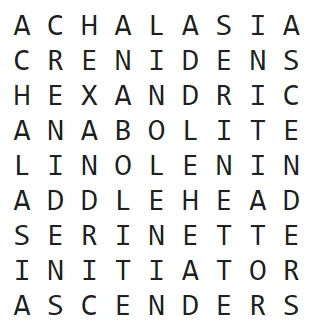
Pompeii's Sator squares are palindromic Latin five-squares. In a language with zero redundancy for words shorter than a particular length, any sequence shorter than that length has meaning. All possible arrangements of letters in a square with sides shorter than that length are valid word squares. As redundancy increases, the number of valid squares decreases. As the square increases in dimension (cube, hypercube, etc.), the permissible redundancy decreases, for each letter must be constituent to a number of words equal to the dimension of the puzzle. Several modifications are required to represent the behavior of actual crosswords, but results are unchanged. The tolerable redundancy decreases with dimension. Decreasing redundancy produces more solutions at a particular dimension. Crosswords can therefore be used to establish an upper bound on the redundancy of a language, or, equivalently, a lower bound on its entropy. And entropy is information, bared.
Your morning crossword, then, is more than an amusement.
This article contains five of the words of a six-square; readers are encouraged to complete the puzzle.
Alternatively, below, from a dictionary of some two thousand uncommon words, Claude and I have created a higher-dimensional crossword puzzle creator; explore the limitations of the English language yourself (and perhaps expand your vocabulary in the meantime).
This article is inspired by the "Crosswords and Codebreaking" chapter of Information Theory, Inference, and Learning Algorithms, one of many marvelous chapters of my favorite textbook. Its author, David MacKay, is one of my (few) personal heroes.