Problem Statement
Global temperatures are rising. Scenarios wherein decarbonization is not achieved (rapidly enough) are increasingly probable. These scenarios require carbon dioxide removal (CDR) at a massive scale. Technologies for carbon dioxide removal, until recently without market incentive, are underdeveloped.
Introduction
I report all masses of carbon dioxide, typically in tonnes (T), 1000 Kg; gigatonnes (GT), 1000 T; or teratons, 1000 GT; and in equivalent quantities of petagrams carbon (Pg). A petagram of carbon is equivalent to 1 GT C, or 3.67 GT CO2.
According to the IPCC, we need to actively remove of the order of a teraton of carbon dioxide (273 Pg C) from the atmosphere by 2100 (Summary for Policymakers. In: Global Warming of 1.5°C, 2018) to limit global warming to 1.5 °C (Figure XX). This is a lot of carbon. Agglomerated into solid graphite, the carbon in a teraton of CO2 would form a cube 5 km per side.
Specifically, at present, atmospheric CO2 has a concentration of 421 parts per million (ppm)–of every million molecules of air, 421 are CO2, about 1 of every 2500. Preindustrial atmospheric CO2 concentration was 180 ppm, but many researchers think realizing concentrations around 340 ppm would be sufficient for ecological stabilization (MIT). To reach atmospheric CO2 concentrations of 180 ppm or 340 ppm, simplistically, removal of 1882 GT CO2 (514 Pg C) or 554 GT CO2 (151 Pg C) would be required, respectively. Capture of 7.82 GT CO2 is required to decrease atmospheric CO2 concentrations by 1 ppm. These figures are not precisely correct because changes in atmospheric CO2 concentration generate changes in the fluxes of carbon from other sinks. Regrettably, we are not, in net, removing CO2 from the atmosphere. According to the World Bank, each year, the average American emits 14 T of CO2 (0.004 Pg C), the US emits 4.5 GT CO2 (1.2 Pg C), and global emissions are 36 GT CO2 (9.8 Pg C). Something must be done!
Removing carbon dioxide from the air is difficult. CO2 is dilute, only 421 ppm, so substantial work is required to produce concentrated CO2. Physically, we can approximate the minimum work required for DAC by calculating the minimum work required for the separation of two ideal gases (per mole of mixture):
wherein \(R\) is the universal gas constant, \(T_0\) is the ambient temperature, and \(X_1\) is the molar fraction of the first species. The work per mole of the first species is
For CO2 with an atmospheric concentration of 421 ppm, this yields a minimum energy of 0.419 MJ/kg CO2 (18.415 MJ/kmol). Modern CO2 separation units achieve efficiencies, by this measure, of approximately 10%. Energy requirements decrease substantially as CO2 concentration increases; This calculator demonstrates the value of capture at source, where concentrations are higher. Upon isolating CO2, decomposition into C and O2 requires 8.943 MJ/kg (393.52 MJ/kmol). Hence CO2 is often fed to synthesis processes (which do not decompose the CO2). Firms like Twelve, Liquid Wind, and LanzaTech are attempting to commercialize chemical production from captured CO2.
To understand the available methods of carbon dioxide removal, it is best first to understand the natural carbon cycle (Figure XX). Human emissions are relatively minor as compared to fluxes from many parts of the natural carbon cycle. The intermediate and deep ocean, for example, store about 37100 GT carbon.
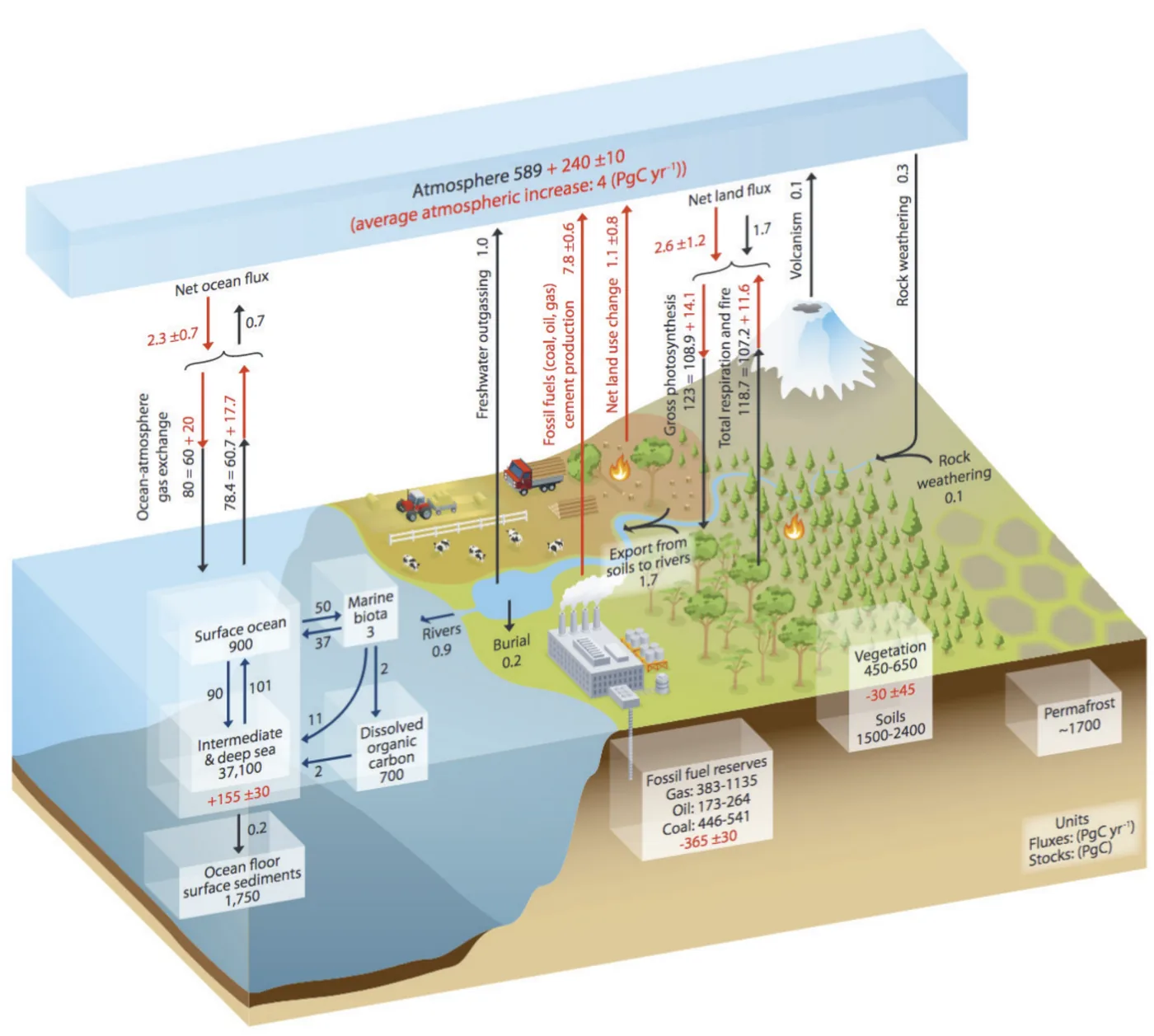
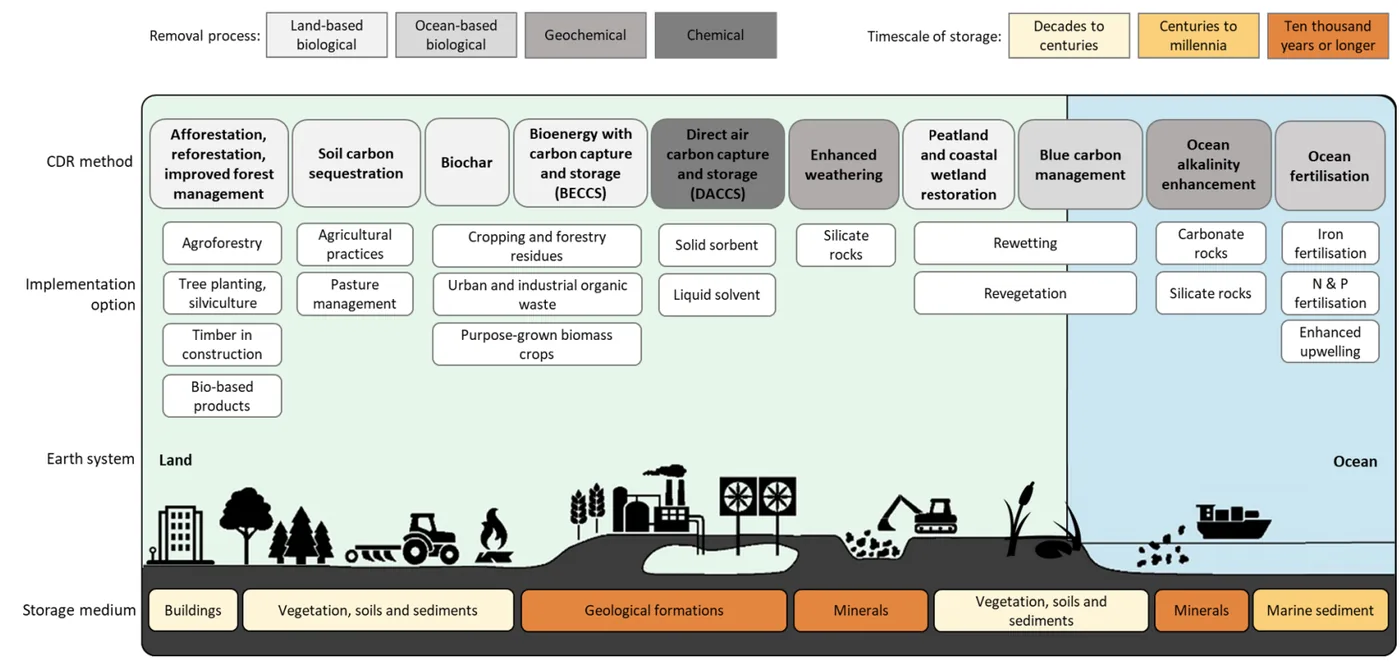
The carbon cycle describes the flux of carbon through the biosphere and carbon sinks–the atmosphere, ocean, lithosphere, etc. Atmospheric carbon exists primarily in CO2 and methane. Atmospheric methane has a global warming potential 84 times that of CO2 but a mean lifetime of only 9.6 years due to reactions with hydroxyl radicals. Atmospheric CO2 has no analogous removal process and a lifetime dictated by the carbon cycle. Barring carbon dioxide removal (CDR), 25% to 30% of carbon accrued from anthropogenic sources is thought to remain in the atmosphere on the order of thousands of years. Natural carbon removal occurs via fixing in terrestrial plants and subsequent decomposition into soil; via fixing in marine biota that sink to the deep ocean; and, more slowly, via the weathering of particular types of rock. The dynamics of carbon reservoirs are not trivial: Adding or removing carbon at any node of the cycle may change the rates of carbon transfer between reservoirs substantially. For example, surface ocean CO2 concentrations increase with atmospheric CO2 concentrations. Ocean acidity has increased correspondingly (by about 30%), slowing biological precipitation of calcium carbonates, decreasing the potential volume of the sink. The fluxes above suggest that teraton-scale carbon capture will be achieved via a portfolio of strategies, some restoring or enhancing natural capture processes, others entirely artificial. The IPCC's most recent summary of CDR approaches can be found in Figure 2.
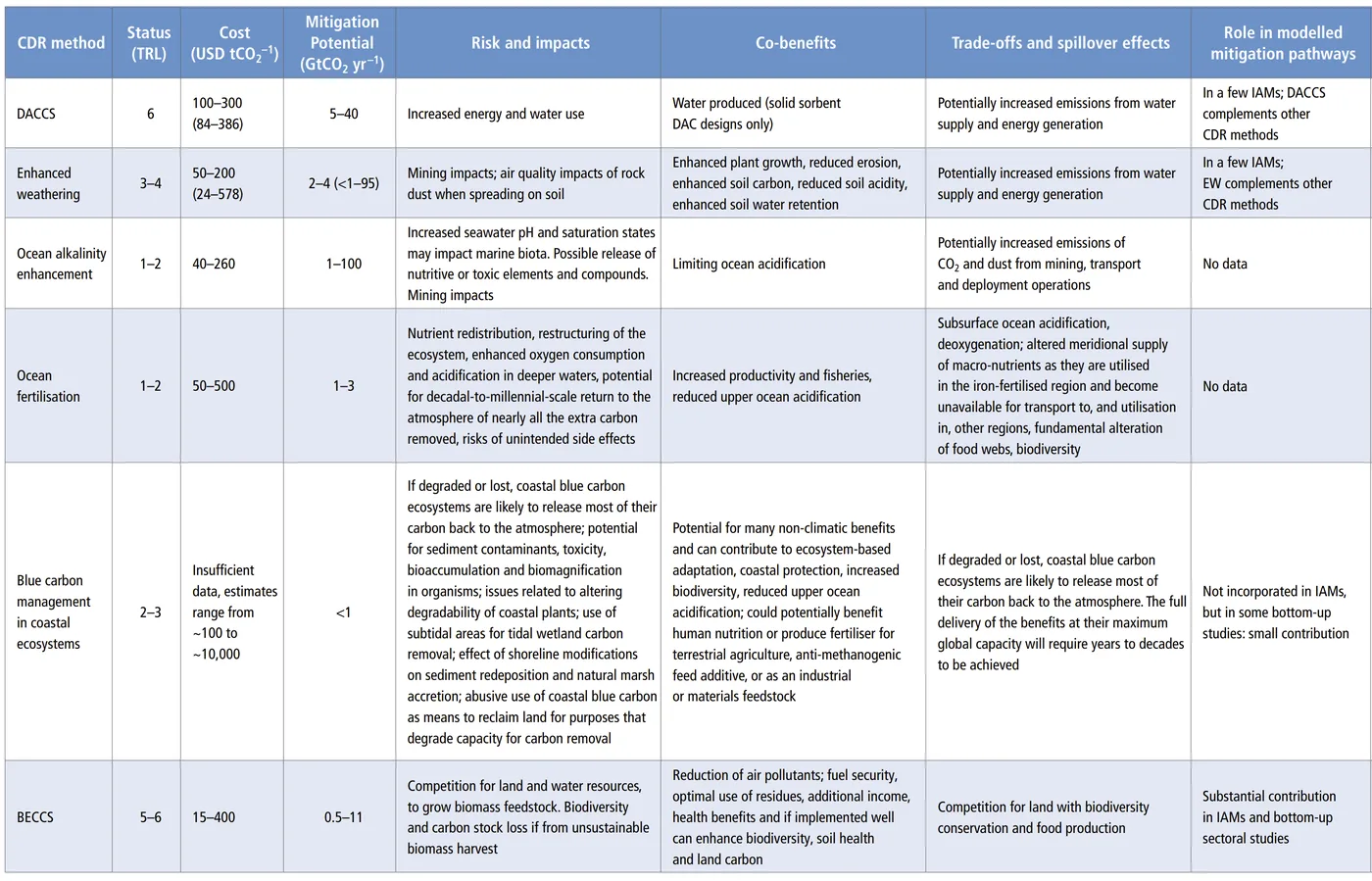
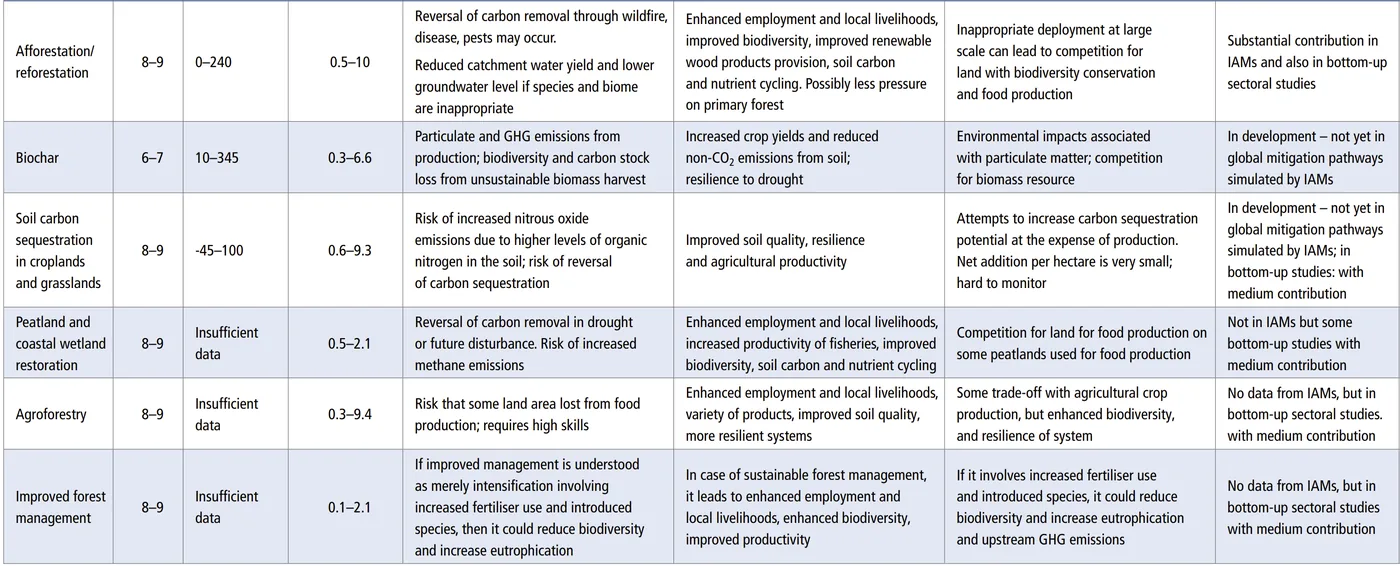
Processes restoring or enhancing natural carbon capture processes are generally well-established (high TRLs) and can be cheap, but have mitigation potentials bounded by environmental or resource constraints. All strategies are detailed in and. I consider those technologies with low TRLs and high mitigation potentials (opportunity!): ocean fertilization, ocean alkilinity enhancement, enhanced weathering, and DAC.
Proposed Solutions
A portfolio of capture strategies with differing cost and performance profiles is being cultivated to meet CCS targets.
Ocean Fertilization
Marine phytoplankton represent approximately half of biologic carbon fixing at a total mass roughly 1% that of biomass on land, 50 Pg C per year.
Ocean Alkilinity Enhancement
Enhanced Weathering
DAC
Conventional direct air capture is a materials problem. Generally, atmospheric gas is flowed through material which removes CO2 via some sorption process. Absorbents, typically liquid, assimilate CO2 throughout their bulk; adsorbents, typically solid, assimilate CO2 only on their surface. Selection or binding of CO2 is necessarily energetically favorable for CO2 sorbents, so the process of CO2 extraction from such materials requires energy input. Sorbent properties dictate the fixed and variable costs of the removal process. Sorbent-based DAC systems typically operate cyclically: atmosphere is flowed through the sorbent until the sorbent is saturated with CO2. Atmospheric flow is terminated, and some release process is initiated. The diversity of adsorbents is described in and is detailed in Appendix.
Three firms, Climeworks, Carbon Engineering, and Global Thermostat, are relatively mature. All are costly, with a
A variety of more interesting ideas have been solicited from
Competitions to encourage innovation in spaces with weak market signals have a storied history, from inspiring Lindbergh's crossing of the Atlantic (and resulting in the deaths of six of his competitors) to the invention of canned food. The $100M 2021 Gigaton Scale Carbon Removal prize is the largest in history. The 15 interim ($1M) winners, selected from an initial 1133 submissions, demonstrate a diversity of carbon removal strategies.
Emerging technology
Faradaic electro-swing
the